





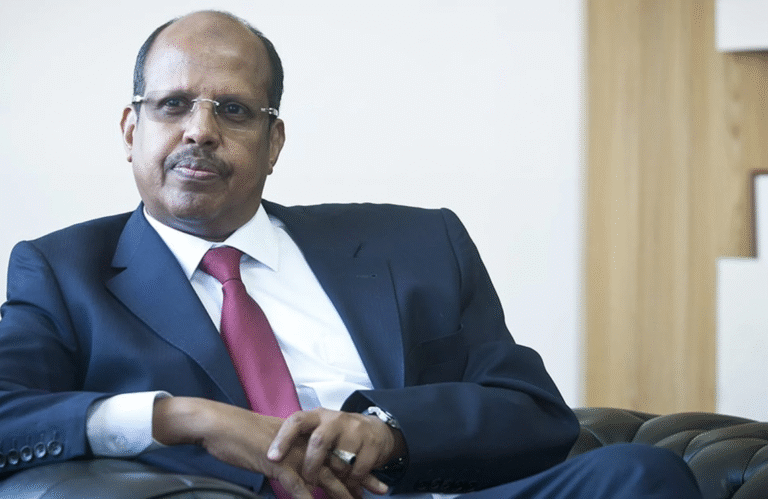
Africa’s debt stock continues to grow, largely due to the high cost of borrowing and limited access to concessional finance, Mahamoud Ali Youssouf, chairperson of the African Union (AU) Commission said.
Addressing the G20–Africa High-Level Dialogue on Debt Sustainability, Cost of Capital and Financing Reforms in Addis Ababa, Ethiopia’s capital on Monday, Youssouf through AU commissioner for Economic, Trade, Tourism, Industry and Mining Francisca Tatchouop Belobe, said in 2024 alone, debt-service payments exceeded $70 billion, consuming an increasing share of public revenues and eroding fiscal space.
“Today, many African governments are spending more on servicing debt than on investing in human development and approximately 57 percent of Africa’s population lives in countries where debt servicing surpasses social spending,” the chairperson said.
He said Africa’s public debt has grown from approximately USD $120 billion in 1990 to now roughly $1.8 trillion, or about two-thirds of the continent’s GDP, while rising debt-service costs are diverting scarce resources in weak economies with barely 3 percent to 4 percent growth per annum.
“These pressures highlight the urgency of collective action to restore debt sustainability and improve Africa’s access to capital on fairer terms,” the chairperson reiterated.
According to the chairperson, the challenge currently facing Africa is not only an African problem, but also a systemic flaw in the global financial architecture.
“It is a system built for a world that no longer should exist, one that measures creditworthiness through biased metrics and perpetuates structural inequality,” Youssouf said.
The challenge, the chairperson said, is not merely to manage debt, but to reimaging the financial architecture that perpetuates this imbalance.
He said a new financial compact that recognizes Africa’s shared responsibility is required to build a more equitable global economy.
As to the chairperson, the G20, as the premier platform for global economic cooperation, has both the mandate and the moral responsibility to lead the way in transforming this architecture.
Under South Africa’s Presidency, he said the G20 has taken significant steps to elevate Africa’s voice.
The creation of the Africa Expert Panel is a powerful signal of intent: to move from consultation to co-creation, from inclusion to real influence.
He the ongoing high-level Dialogue offers an opportunity to challenge long-held assumptions, identify concrete solutions, and craft an agenda for fairer access to finance and meaningful reform.
MG/as/APA