



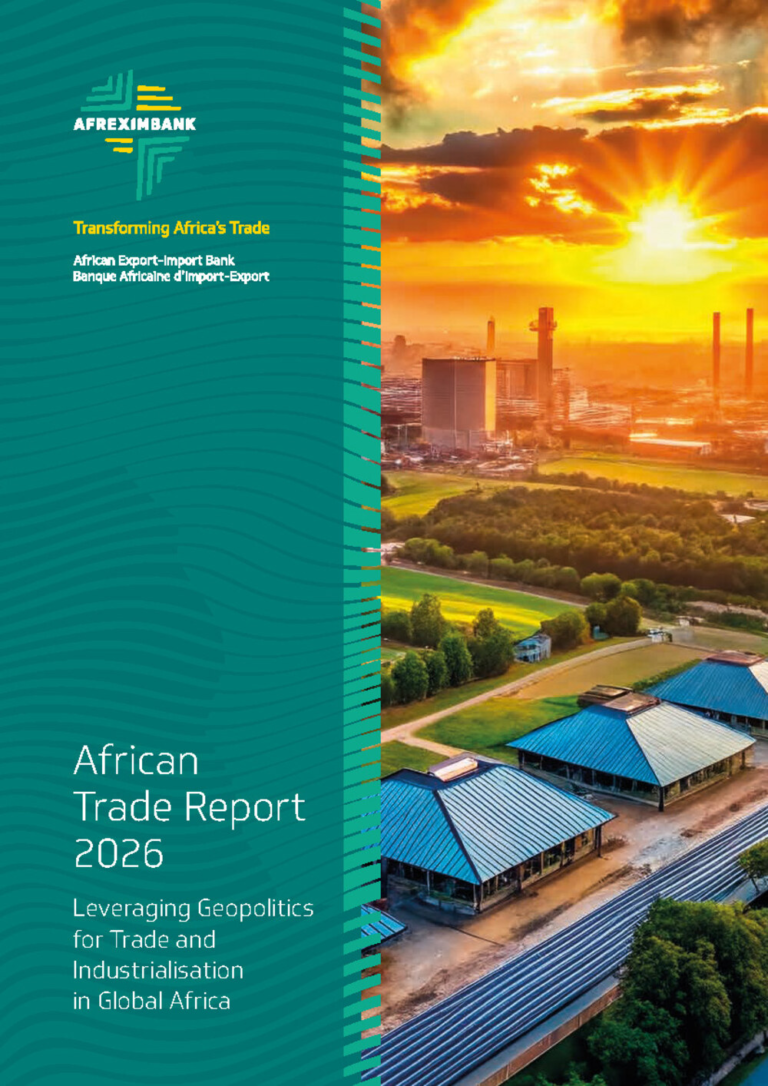
Despite a global environment marked by geopolitical tensions, supply chain disruptions and slowing economic growth, Africa has a historic opportunity to accelerate industrialisation and strengthen its economic resilience, according to the 2026 African Trade Report released by Afreximbank.
The African Export-Import Bank (Afreximbank) unveiled the latest edition of its flagship report, titled “Harnessing Geopolitics for Global Africa’s Trade and Industrialisation.” The study examines ongoing transformations in the global economy and highlights strategies that could enable the continent to turn current geopolitical challenges into drivers of sustainable growth and shared prosperity.
According to the report, Africa continues to demonstrate remarkable resilience. While global economic growth slowed to 3.4 percent in 2025 and is projected to ease further to 3.1 percent in 2026, Africa’s real GDP growth accelerated from 3.4 percent in 2024 to 4.5 percent in 2025.
The continent’s merchandise trade also expanded by 6.1 percent to reach approximately $1.5 trillion, while average inflation fell from 21.6 percent to 13.1 percent over the same period. The report attributes these gains to prudent macroeconomic management, continued structural reforms and support from African development finance institutions.
For Afreximbank Chief Economist Yemi Kale, the current geopolitical realignment presents Africa with a unique opportunity to strengthen regional value chains and enhance its competitiveness.
“Africa stands at a pivotal moment. Geopolitical tensions are reshaping global trade patterns, but they also offer the continent a historic opportunity to build a more resilient, competitive and inclusive economy,” he said.
The report nevertheless highlights several persistent constraints, including a trade finance gap estimated at $74 billion in 2025. Limited foreign-currency liquidity and the continued decline in correspondent banking relationships also remain significant obstacles to the continent’s export capacity.
These challenges are compounded by prolonged disruptions to global logistics networks and evolving maritime trade routes, which are extending delivery times and increasing transportation costs, particularly for economies that depend heavily on imports and external markets.
In response, Afreximbank advocates accelerated implementation of the African Continental Free Trade Area (AfCFTA), broader adoption of the Pan-African Payment and Settlement System, and coordinated reforms of the international financial architecture.
The report also highlights the growing role of African financial institutions. Afreximbank disbursed $17.5 billion in 2024 and aims to double financing for intra-African trade by 2026. Meanwhile, PAPSS is already helping to reduce the cost of cross-border transactions and lessen dependence on foreign currencies.
According to the institution, Africa’s ability to benefit from the ongoing reconfiguration of the global economy will depend on its capacity to strengthen industrial capabilities, expand intra-African trade and mobilise adequate financing. It argues that swift and coordinated action is now essential if geopolitical disruptions are to be transformed into long-term development opportunities.
TE/Sf/lb/as/APA