





Inheriting a precarious financial situation, the national carrier Air Senegal SA presented its recovery strategy on Thursday during the “Ndogou (breaking of the fast) of the Press 2026,” reporting encouraging initial results but significant projects still pending, including the thorny issue of the fleet.
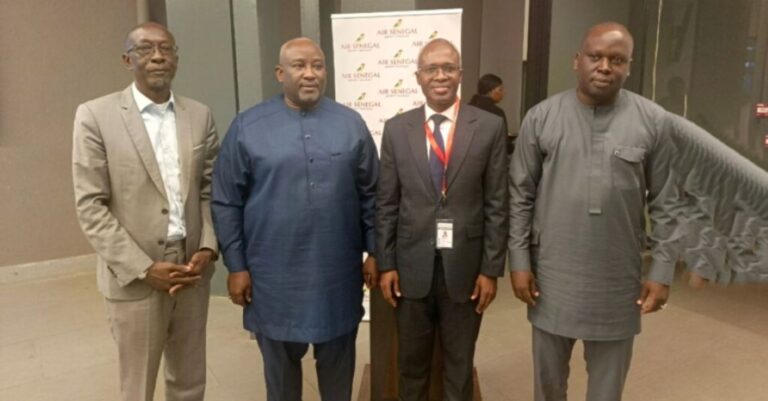
Air Senegal SA organised the 2026 edition of its eNdogou of the Presse on Thursday, under the leadership of its CEO, Tidiane Ndiaye, to present the company’s recovery prospects and the challenges related to the development of the national air hub.
A Critical Inherited Situation
When the new General Management took office in August 2024, Air Senegal SA had a total debt of 118 billion CFA francs – 52 billion owed to private partners and 66 billion to public entities -cumulative losses of 139 billion for the 2022 and 2023 fiscal years, a fleet reduced to 50% of its initial capacity, and a real risk of operational disruption in the short term.
The state taking action for recovery
Faced with this situation, an inter-ministerial council dedicated to the company’s recovery was held on April 3, 2025, chaired by the prime minister.
Several key decisions were made: clearing operating debts, mobilising working capital, rebuilding equity, and creating specialised subsidiaries, including Air Senegal Express.
These guidelines were reaffirmed at the Council of Ministers meeting on February 11, 2026, with instructions for implementation within 30 days.
Initial results
Rationalisation measures undertaken by the general management have reduced the deficit by 24 percent between 2024 and 2025, lowered operating expenses by 11.5 percent, and generated average savings of 3.4 billion CFA francs per month.
The company also continued to pay its employees’ salaries without requesting government assistance, despite its significant reliance on leased aircraft.
Regarding debt, commitments to private partners were reduced from 52 billion to 37 billion. However, the debt to public entities increased to 94 billion.
A mechanism for offsetting cross-debts between public entities, currently being formalized, could eliminate approximately 71 billion.
Fleet renewal starting at the end of March 2026
Air Senegal SA has defined a strategy for the gradual acquisition of 15 Boeing aircraft by 2035. The first phase involves the introduction, starting at the end of March 2026, of six Boeing 737 NG passenger aircraft and one Boeing 737 freighter, with the objective of having a fully owned and managed fleet by the second half of 2026.
The Diass hub, a strategic issue
The company advocates for strategic alignment between Air Senegal SA, Blaise Diagne International Airport (AIBD SA), and ground handling services (LAS), which are currently managed within separate
institutional frameworks, thus “limiting strategic alignment with the national airline.”
No opening of the parent company’s capital
Deputy Managing Director Farba Diouf explained that the State, the sole shareholder through the Deposits and Consignments Fund (CDC), has not expressed any desire to open the capital of the parent company.
However, the group’s subsidiaries, including Air Senegal Express, are open to private and foreign investors. “We are waiting on their interest to be able to proceed with this opening of the capital,” he said.
With regard to financing, the Deputy Director General explained that rebuilding equity – estimated at 235 billion in 2024 – does not require any disbursement from the state.
It would rely on a “reverse stock split,” a mechanism consisting of converting State loans into shares, which would bring equity back to zero and pave the way for raising funds from banks. “We are not asking the Treasury to release any money,” he said, stressing that the decisions made in April 2025
and reiterated in February 2026 “are still awaiting implementation.”
Three aircraft in service: the root cause of delays
The commercial and marketing director, Assane Sambe, identified the lack of aircraft as “the major problem” for the company. Air Senegal currently has only three aircraft in service, all leased, which makes the company particularly vulnerable to technical issues.
“If tomorrow the plane bound for Paris breaks down, you’ll hear in the press that Air Senegal has canceled another flight,” he acknowledged, pointing out the impossibility of quickly replacing a
malfunctioning aircraft, unlike airlines such as Air France, which have over 400 planes.
As for communication gaps during disruptions, Mr. Sambe explained that the airline’s automatic alert system can only reach passengers who have provided their contact information in their booking, which is not always the case.
AC/fss/as/APA