





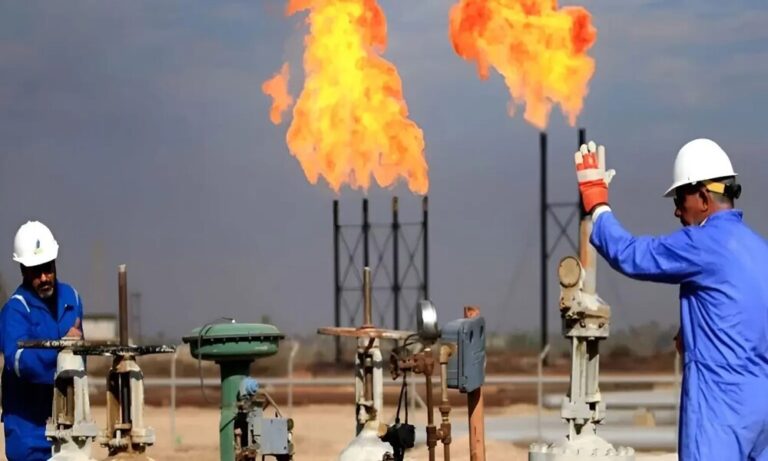
The temporary suspension of Qatari exports has propelled Sonatrach to the forefront, but it also highlights the structural weaknesses of the Algerian gas model.
The temporary paralysis of a portion of Qatar’s Liquefied Natural Gas (LNG) exports, following drone attacks targeting the strategic facilities at Ras Laffan and Mesaieed, has sent shockwaves through global energy markets.
In this context of extreme tension, Algeria is attempting to position itself as a substitute supplier, mobilizing its national company Sonatrach to increase production and capture a share of the unmet demand.
However, behind this aggressive stance, Algiers’ actual capacity to play a stabilizing role remains questionable.
According to the Washington-based specialized platform Attaqa, Sonatrach plans to maximize its liquefaction capacity to capitalize on soaring prices and partially compensate for the absence of Qatari shipments. Algeria has an estimated liquefaction capacity of approximately 25.3 million tonnes per year, distributed among several industrial complexes located primarily in Arzew and Skikda.
In Arzew, the GL1Z and GL2Z complexes each have six liquefaction trains, with respective capacities of 7.9 and 8.2 million tonnes per year, in addition to the GL3Z complex, capable of producing 4.7 million tonnes. In Skikda, another facility contributes 4.5 million tonnes per year.
On paper, this infrastructure positions Algeria among the leading liquefaction hubs in Africa. However, the gap between installed capacity and actual export volumes illustrates the limitations of the Algerian energy system. In 2025, the country’s LNG exports fell by 18%, dropping to 9.54 million tonnes, a level significantly lower than
the record 13.45 million tonnes reached in 2023.
This contraction underscores the persistent difficulties related to the state of infrastructure, technical constraints, and insufficient investment to modernize facilities.
The current gas market crisis comes at a time when European prices have surged. On Monday, March 2, 2026, gas prices in Europe jumped by approximately 40%, registering their largest daily increase since August 2023. This tension is largely due to disruptions in the Strait of Hormuz, a strategic waterway through which nearly 20% of global LNG trade passes.
According to maritime tracking data, at least 24 LNG carriers have already altered their courses to avoid the conflict zone. Goldman Sachs analysts estimate that a prolonged blockade of the Strait of Gibraltar for a month could lead to a doubling of gas prices in Europe and a 130% increase in spot prices in Asia. In this context, Algeria is seeking to capitalize on its geographical proximity to Europe, an undeniable logistical advantage over Gulf suppliers.
However, Algiers’ attempt to establish itself as a pillar of Mediterranean energy security is hampered by several structural realities. Despite significant gas resources and a long-standing industrial heritage, the Algerian energy sector remains heavily dependent on Sonatrach, whose performance is regularly hampered by technical constraints, investment delays, and an institutional environment deemed unattractive by many international investors.
The structure of LNG exports in 2025 nevertheless illustrates the continued dependence of certain European markets on Algerian gas. Turkey absorbed approximately 3.14 million tonnes, followed by France with 2.31 million tonnes, Italy with 1.62 million tonnes, and Spain with 1.44 million tonnes. These flows reflect a long-standing energy
relationship, but also a market where competition is intensifying in the face of the rise of American, Qatari, and Australian LNG.
At the same time, Algiers is considering redirecting some shipments to Middle Eastern countries facing supply shortages, notably Egypt, Kuwait, Jordan, and Bahrain. This strategy aims to exploit the window of opportunity created by the temporary halt of Qatari exports.
But this situation also highlights the Algerian energy paradox. Despite its ambitions and resources, the country is struggling to sustainably translate its capacity into global energy influence. Recurring production fluctuations, insufficient modernization
projects, and near-exclusive dependence on Sonatrach limit Algiers’ ability to establish itself as a leading supplier in an increasingly competitive and volatile gas market.
Thus, while the current crisis offers Algeria a temporary opportunity to strengthen its presence in the LNG market, it also reveals the weaknesses of an energy model still largely dependent on internal structural factors.
MK/AK/fss/gik/APA