





A seminar of the Algerian People’s National Army (ANP) highlights a strategic “innovation,” as part of unresolved structural challenges.
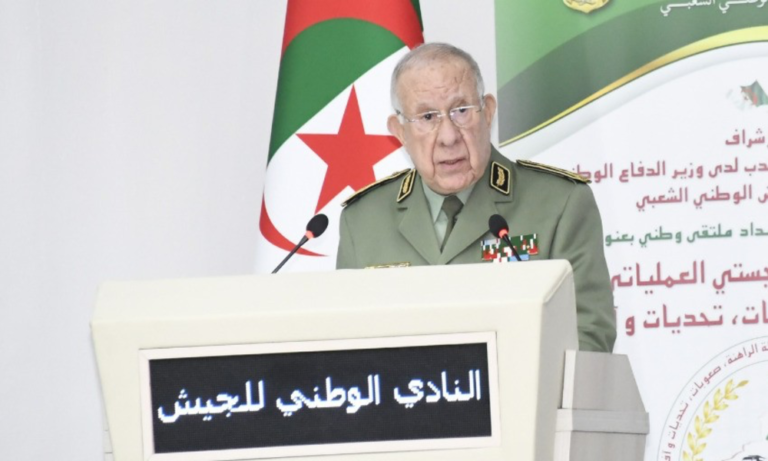
The Chief of Staff of the People’s National Army (ANP), General Said Chanegriha, chaired a national seminar dedicated to “the operational logistics support chain,” according to official statements.
The seminar aimed to assess the state of Algeria’s military logistics capabilities and identify operational constraints.
Held at the National Army Circle in Beni Messous, the event brought together several high-ranking civilian and military officials in a regional context marked by persistent security tensions in the Sahel.
Building on this initiative, the military command emphasised its commitment to adapting to “complex and evolving operational contexts,” stressing the need for an “innovative strategy” to meet the demands of modern conflicts.
The official discourse emphasizes an ambition for total integration between operational and logistical components, presented as a key lever for ensuring the availability of forces in the field.
However, this emphasis on a strategic overhaul comes in an environment where the Algerian People’s National Army’s (ANP) logistical capabilities remain poorly documented publicly, fueling observers’ questions about the gap between stated objectives and their actual implementation.
The focus on diagnosing “difficulties and challenges” suggests the existence of structural constraints, particularly in terms of coordination, flow management, and technological adaptation.
Following this interpretation, the insistence on the need to ensure “the flow of resources at the opportune moment” reflects a classic challenge for armies operating in unstable environments, especially in the neighbouring Sahel region.
Yet, despite high defense budgets by African standards, the operational implementation of these resources continues to raise concerns about their actual effectiveness on the ground. Beyond the
institutional display, this seminar illustrates an attempt at doctrinal repositioning in the face of evolving threats, while also highlighting the limitations of a still largely centralised military
model.
The emphasis placed on innovation and coordination thus appears as a response to internal vulnerabilities, in a context where the operational credibility of the Algerian People’s National Army (ANP) remains a major strategic issue for Algeria and its regional environment.
MK/AK/Sf/fss/as/APA