



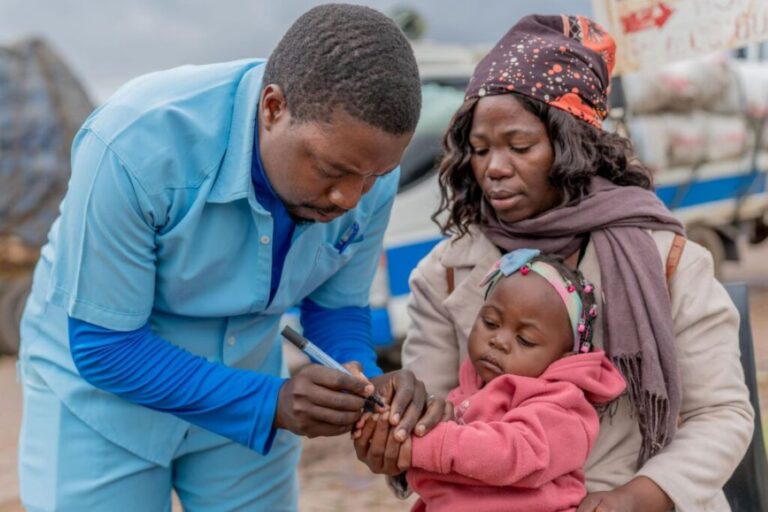
The government of Benin, with the support of its technical and financial partners, launched a polio vaccination campaign on Friday, at a ceremony held in Sakete Stadium, in the presence of many officials and representatives of international organisations.
The large-scale polio vaccination campaign launched in Benin targets children aged 0 to 5 years in six departments of the country: Alibori, Atacora, Borgou, Donga, Collines, and Plateau. A total of 2,516,862 children are targeted by this first round of vaccinations, scheduled from April 24 to 27, 2026.
Speaking at the event, the UNICEF Representative in Benin, Ousmane Niang, commended the government’s efforts in the fight against vaccine-preventable diseases.
He did, however, warn of the continued presence of poliovirus in the country, with cases detected regularly since 2022. According to him, unvaccinated or insufficiently vaccinated children are a key factor in the spread of the virus.
He therefore called for strong mobilization of communities, local leaders, and parents to ensure the success of the campaign.
The UNICEF representative also emphasized the importance of routine immunisation, which he considers the most effective way to provide lasting protection for children and reduce infant mortality.
For his part, the Minister of Health, Professor Benjamin Hounkpatin, reiterated the seriousness of polio, a highly contagious viral disease that can lead to irreversible paralysis and even death.
Despite the progress made, three environmental cases of poliovirus were recently detected in Benin, justifying the implementation of this two-phase response campaign, in accordance with the recommendations of the World Health Organization (WHO). “The objective is clear: to interrupt all
chains of transmission of the virus,” declared the minister, specifying that the campaign aims for vaccination coverage of at least 95%, a threshold deemed necessary to stop the circulation of
poliovirus.
He emphasised three essential factors for the success of this operation: the mobilisation of all stakeholders, parental commitment, and the rigor of the vaccination teams.
Vaccination agents will be deployed in the field to visit households and administer vaccine doses to all eligible children.
The minister appealed to parents to facilitate their work by opening their homes and having their children vaccinated. “Tomorrow’s health is built today,” he stressed.
The launch ceremony was held in the presence of the Prefect of Plateau, the Mayor of Sakété, and the Resident Representative of the World Health Organization in Benin.
Partners such as the WHO, UNICEF, Gavi, and several civil society organizations were thanked for their ongoing support.
Through this initiative, Benin reaffirms its commitment to definitively eradicating polio and guaranteeing every child the right to a healthy life.
The message to the population is unequivocal: vaccinate children to protect them against this
preventable disease.
TE/Sf/fss/as/APA