





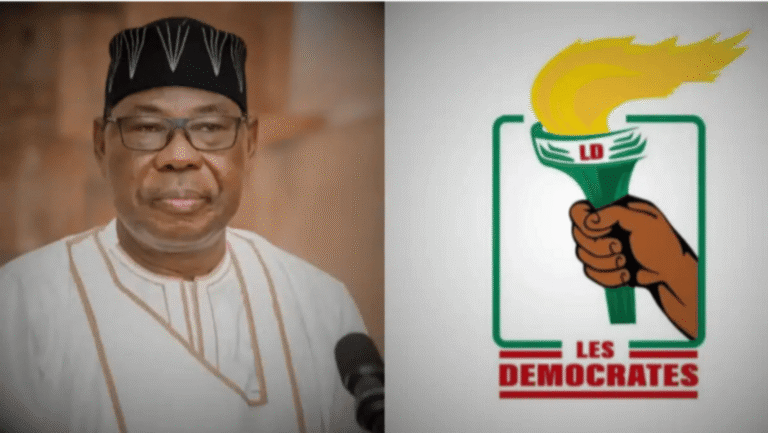
The Democrats party in Benin has experienced a significant political setback after failing to secure any seats in the new National Assembly, representing a historic exclusion for the leading opposition group.
Despite maintaining its position as the country’s third-largest political force, the party was unable to translate its supporter base into parliamentary representation due to a fragmentation of votes that proved incompatible with the requirements of the current electoral code. This defeat marks a critical turning point for a party that has been heavily structured around the personal influence of former President Thomas Boni Yayi since its inception.
The outcome of the elections highlights the limitations of the party’s reliance on hyper-personalization and the “cult of personality” surrounding its mentor. While Boni Yayi’s aura initially provided visibility and political capital, it has recently struggled to compete against rival parties that focused on disciplined collective organizations and tight territorial networks. In the current Beninese political system, which prioritizes territorial performance and organizational strength, simply opposing the executive branch has proven insufficient for institutional survival.
This resounding defeat raises urgent questions about the future of The Democrats and the necessity of a profound internal transformation. To remain relevant in the evolving political landscape, the party faces the challenge of moving beyond its identity as an extension of a personal legacy. Observers suggest that a generational and programmatic renewal is essential for the party to evolve into a structured organization capable of offering a credible alternative for governance; without such changes, the party risks gradually fading from the national political scene.
AP/fss/abj/APA