



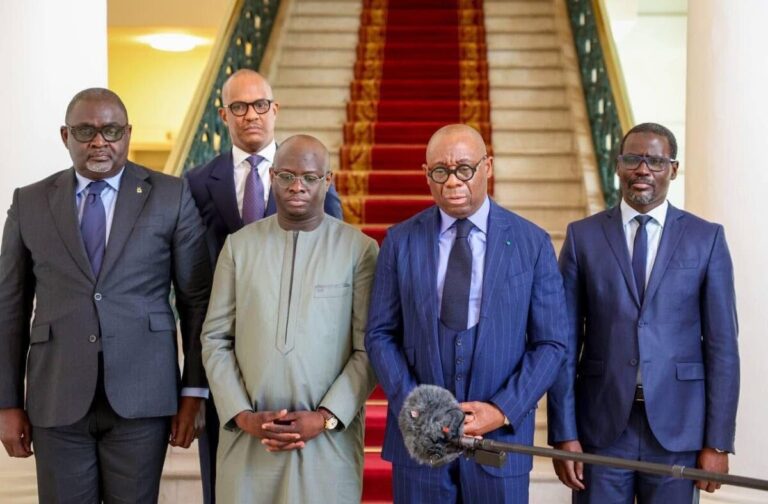
The West African Development Bank (BOAD) inaugurated the new premises of its resident mission in Senegal on Thursday in Dakar, marking a new step in its integration within the Senegalese economy and the UEMOA region.
In an atmosphere that blended solemnity and conviviality, institutional leaders, public and private partners, and representatives of the financial sector attended the inauguration of the BOAD’s new offices, which the institution’s leaders presented as much more than a simple change of address.
For BOAD President Serge Ekué, this move symbolizes the institution’s commitment to getting closer to the economic and social realities of its member countries. “BOAD is a social and societal actor. It must be at the heart of the real lives of our people,” he declared.
Serge Ekué also emphasized BOAD’s commitment to expanding its partnerships with the Senegalese private sector.
“We work extensively with the public sector, but we also aim to collaborate more and more with the private sector. Hence the choice of this new space, which will allow us to welcome our partners, clients, shareholders, and investors in an environment characterized by simplicity, transparency, efficiency, and professionalism,” he explained.
The BOAD president emphasized that the new premises reflect the approach the institution wishes to promote in the country.
“There’s nothing flashy here. These premises simply reflect our commitment to working closely with entrepreneurs, creators, and the Senegalese government to support the country’s development,” he stated.
According to him, this establishment aims to strengthen economic ties between the regional bank and Dakar.
“We must establish teams here in Senegal capable of supporting the country’s ambitions over the next 20, 30, or 50 years,” he added. The head of the BOAD also reiterated the institution’s development focus, whose priorities remain addressing infrastructure, energy, and social housing deficits, as well as challenges related to health and digital technology.
“We are not obsessed with the bottom line,” he stated, emphasizing that the bank’s primary mission is the tangible improvement of living conditions for the people of the West African Economic and Monetary Union (WAEMU). Having been housed for over 30 years in the premises of the Central Bank of West African States (BCEAO), the BOAD’s resident mission is thus embarking on a new phase of its development in Senegal, the bank’s second-largest country of exposure in terms of financial commitments.
The BCEAO’s national director for Senegal, François Etienne Dethie Sene, hailed “a moment rich in history and emotion,” recalling that the central bank’s hosting of the BOAD has for decades reflected “institutional solidarity” and “the shared vision” of the two regional institutions.
According to him, this inauguration also illustrates the evolution of the BOAD and the strengthening of regional cooperation in service of a “more integrated, more resilient and more prosperous” UEMOA.
The BOAD president also presented the main points of the new 2026-2030 strategic plan, entitled “Djoliba, the sequel.” The institution plans to allocate 6.5 trillion CFA francs in financing to this plan, nearly double the previous programme.
In an international context marked by dwindling financing and geopolitical tensions, Serge Ekué affirmed that the BOAD intends to fully play its role as the “financial arm” of the WAEMU member states.
In Senegal, the bank is already supporting several structuring projects in the areas of education, energy, digital technology, and infrastructure, including agricultural vocational high schools, the national gas pipeline, solar power plants and the modernization of data centers and the submarine cable.
“If we do not make a concrete contribution to improving the living conditions of the population, then we are useless,” concluded the president of the BOAD, calling on the countries of the Union to preserve their unity in the face of economic, climatic and geopolitical crises.
ARD/te/Sf/fss/gik/APA