



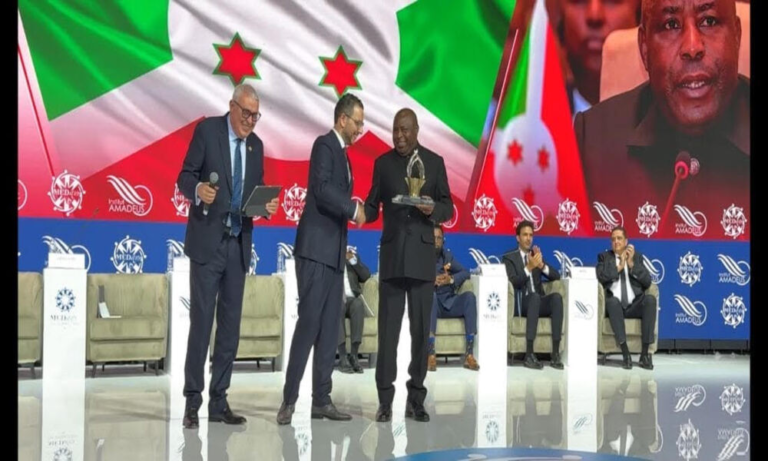
The Amadeus Institute on Wednesday evening in Tangier awarded the 2026 MEDays Grand Prize to the presidents of Burundi, Évariste Ndayishimiye, the current chairman of the African Union, and Sierra Leone, Julius Maada Bio.
The 2026 MEDays Award was also presented to the president of the Co-operative Republic of Guyana, Mohamed Irfaan Ali.
The distinctions were presented at the opening ceremony of the 18th MEDays International Forum, which runs through November 28 in Tangier under the high patronage of King Mohammed VI, on the theme “A Fragmented World: Time for Choices.”
Ndayishimiye received the distinction for his work in support of dialogue and cooperation on the continent. His commitment to sustainable access to water and sanitation, the African Union’s theme for 2026, aligns with a priority of the kingdom, according to a statement from the Amadeus Institute.
“The opening of Burundi’s consulate general in Laayoune reflects the friendship between the two countries and Bujumbura’s steadfast support for the Moroccan character of the Sahara,” the statement said.
The forum also hailed Maada Bio’s leadership in support of West African integration, notably during his term as head of the Economic Community of West African States (ECOWAS).
The first West Africa Integration and Investment Summit, held in Freetown from November 16 to 18, 2026, brought together public authorities and investors around regional projects, the Institute noted. It added that Sierra Leone’s consulate general in Dakhla, in the Western Sahara, and the country’s vote for UN Security Council Resolution 2797 demonstrate its steadfast support for the kingdom’s territorial integrity.
The MEDays Award honours Mohamed Irfaan Ali for his commitment to bringing Africa, South America and the Caribbean closer together. Through its dual South American and Caribbean identity, Guyana acts as a link in this dialogue, the statement said, noting that the forum also expressed its gratitude for his country’s vote in favour of Resolution 2797 when it sat on the Security Council.
Sierra Leone aspires to deepen its cooperation with Morocco in trade, investment, agriculture and energy, President Maada Bio said.
Speaking at the opening of this edition, President Bio highlighted prospects for strengthening relations between his country and Morocco, notably in trade, investment, agriculture and energy, stressing the kingdom’s role as an important partner in this effort.
Maada Bio also welcomed King Mohammed VI’s initiative to facilitate access for Sahel countries to the Atlantic Ocean, as well as the Nigeria-Morocco African Atlantic gas pipeline project. These initiatives offer important prospects for strengthening regional connectivity and the continent’s economic integration, he said.
He noted that ties between the two countries go back several centuries, citing in particular the journey of the Moroccan explorer Ibn Battuta, who set out from Tangier to cross the Sahara toward the Mali Empire.
Addressing international issues, Maada Bio pointed to the growing interdependence of economies, stressing that international conflicts, decisions made in major financial centres and shifts in trade policy have direct repercussions on African economies, notably in fuel prices, borrowing costs and producers’ livelihoods.
Morocco offers a model for Africa, showing that a country on the continent can control its energy supply, transform its economy and establish itself as an emerging nation, Ndayishimiye said.
“From the Noor solar complex in Ouarzazate to the Tanger Med port, including its automotive industry, one of the continent’s first, Morocco has just given us a model,” Ndayishimiye said, adding that the kingdom can share the factors behind its success, while other countries on the continent can make full use of their own assets.
Organised by the MEDays Forum Foundation and the Amadeus Institute, this edition comes at a time of lasting fragmentation of the world order, realignment of alliances, the assertion of new sovereignties and intensifying geopolitical, economic, energy and technological rivalries.
Debates will focus in particular on sovereignty, alliances, leadership, security, industrialisation, energy, new value chains, artificial intelligence, strategic resources, and African, Atlantic and South-South cooperation.
AK/Sf/lb/as/APA