





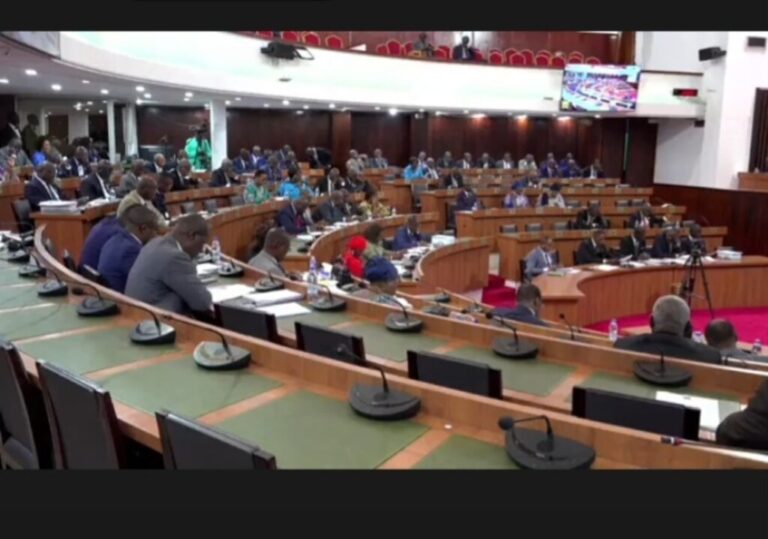
Côte d’Ivoire’s National Assembly Economic and Financial Affairs Committee has unanimously adopted the state budget for the 2026 fiscal year, which totals over CFA 17 trillion.
The budget features a significant 13 percent increase from the previous year, targeting a robust tax revenue base of CFA 8.193 trillion.
This projected tax revenue figure represents a substantial leap from the previous year’s level (over CFA 5 trillion in 2025) but, as noted by the Head of State’s representative during the presentation, remains below the country’s full development needs.
To achieve the ambitious CFA 8.193 trillion target, the government is focusing on integrating the informal sector and increasing the overall number of taxpayers. The Ministry of Commerce has initiated a systematic census of traders to issue them identification cards, thereby facilitating their entry into the tax system.
Furthermore, the government is utilizing advanced technology to identify new taxpayers. This includes: Drone surveys of land parcels as part of the cadastral survey effort. The widespread rollout of the recently implemented standardized electronic invoicing system.
These collective efforts are designed to broaden the tax base and maximize state revenue to address the country’s significant development challenges.
Discussions also addressed the nation’s debt. The representative of the Head of State reported that current Ivorian debt servicing is estimated at 38.47 percent of the budget, with the debt service-to-tax-revenue ratio at 21.4 percent.
In response to concerns, the representative reassured the committee that the debt situation is assessed primarily on its sustainability, evaluated through indicators such as debt, liquidity, and solvency ratios. Regular analyses confirm this sustainability, with a downward trend in the main ratios attributed to fiscal consolidation and active management of Ivorian debt.
Despite the positive financial outlook, the Commission highlighted a major operational constraint: a “shortage of teachers in science subjects.” The Commission urged the government to find an “urgent solution to this problem.”
The representative of the Head of State reiterated that human resource development is central to government policy, noting that nearly a third of the Ivorian budget is already dedicated to human capital development. Nonetheless, the Commission called for specific measures to address the science teacher shortage, even with the planned recruitment of 34,802 civil servants in 2026.
AP/fss/abj/APA