



With a local processing rate now reaching 57%, Côte d’Ivoire has already surpassed the 50% target
initially set for 2030.
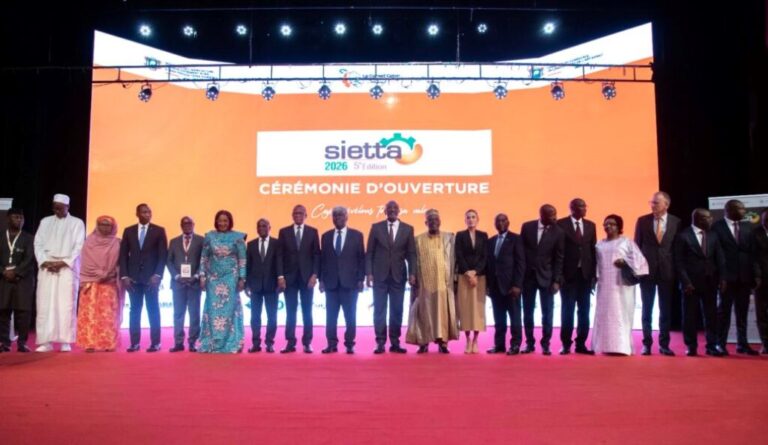
This historic leap was highlighted during the opening of the 5th edition of the International Exhibition for Cashew Processing Equipment and Technologies (SIETTA) on Thursday, November
26, 2026, in Abidjan.
The official opening ceremony for SIETTA 2026 was presided over last Thursday by Ivorian Prime Minister Robert Beugre Mambe, an event that also marked the 10th anniversary of the International Cashew Advisory Council (ICAC).
The Treichville Palace of Culture is hosting this major gathering for Africa’s cashew industry from November 26 to 28, 2026. The initiative was commended by the outgoing president of the ICAC – who also serves as Cameroon’s Minister of Agriculture, Gabriel Mbairobe – before an audience of thousands of participants.
While the country processed barely 2% of its harvest in 2011, and 43% (approximately 660,000 tonnes) in 2025, it now reports a rate of 57%. The figures, unveiled by the Minister of Agriculture, Rural Development, and Food Crops, Bruno Kone, reflect a profound transformation.
As the world’s leading producer of raw cashew nuts, Côte d’Ivoire has now established itself as the third-largest processor globally and the second-largest exporter of cashew kernels. In financial terms, export revenues for the sector surpassed the 1 trillion CFA franc mark in 2025.
This momentum accelerated in 2026: by the end of September, the volume of cashew kernels exported had nearly reached the total for the entire previous year. Buoyed by these results, the government is raising its ambitions.
“On October 29, in Geneva, before the World Trade Organization, the head of state set a clear course: to process at least 80% of our cashew production within Côte d’Ivoire by 2030,” noted Bruno Kone, emphasizsing the need to improve quality and capture new markets.
Under the them: “Cashew Processing Beyond the Kernel,” this 5th edition of SIETTA – which expects nearly 7,000 visitors, according to Mamadou Berte, Director General of the Cotton, Cashew, and Shea Council – aims to reinvent the value chain.
Until now, the Ivorian industry has focused almost exclusively on the kernel, missing out on significant sources of value. In 2025, processing plants generated approximately 460,000 tons of cashew shells – which are often burned or left in piles – while nearly seven million tons of cashew apples rot in orchards every year.
“What goes up in smoke, what rots on the ground – that is lost wealth,” warned Minister Bruno Kone, calling for the utilisation of these by-products (such as nut-shell liquid, juice, and biofuels).
Through SIETTA, the state aims to accelerate progress in areas including women’s employment, financing, and technological sovereignty.
Beyond macroeconomic performance, local processing serves as a major social catalyst. The sector generates nearly 20,000 direct jobs, 66% of which – or two out of every three positions – are held by women.
“Behind the cashew nut lies the empowerment of women,” emphasised Mamadou Berte.
To reach the next level, Prime Minister Robert Beugre Mambe has identified two priorities: local innovation and financing. He urged Ivorian youth to pursue fields in science and technology so that the necessary industrial equipment can be designed and manufactured domestically.
The head of government also issued an urgent call to the banking sector to provide greater support to stakeholders in the industry.
Present at the opening, the representative of the European Union (EU) delegation to Côte d’Ivoire commended the country for its successful transition toward becoming a processing nation – a true “key to employment.”
At the same time, she urged economic operators to fully integrate the traceability requirements mandated for entry into the European market.
Far from viewing these as a hindrance, she encouraged the sector to embrace this standard as “an opportunity” to boost its international competitiveness.
AP/Sf/fss/as/APA