



Côte d’Ivoire is about to enter the era of high-speed rail.
As part of its new National Development Program (PND 2026-2030), the government plans to build a high-speed train (TGV).
Connecting the south and north of the country over a distance of 640 km, the future Ivorian rail corridor will link the strategic hubs of Abidjan (South), Yamoussoukro, Bouaké (centre), Korhogo, and Ferkessédougou (north).
Beyond the technical challenge, this infrastructure promises to revolutionise regional planning and the daily lives of Ivorians.
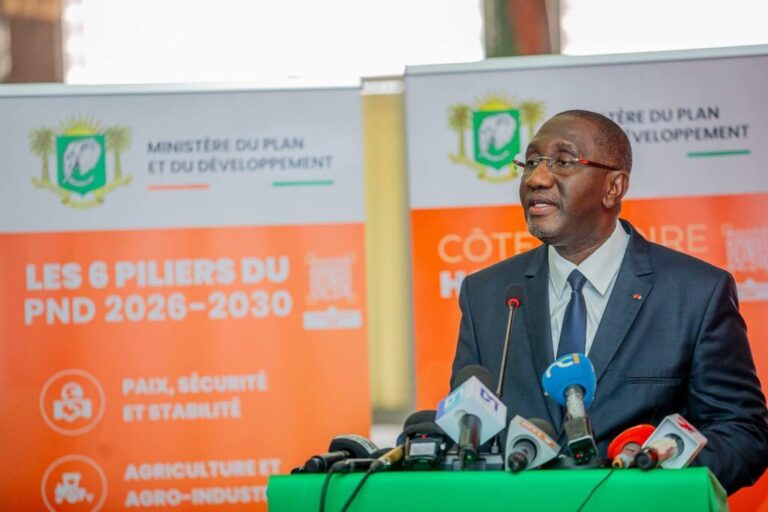
According to the Minister of Planning and Development, Souleymane Diarrassouba, this TGV will connect the economic hub (Abidjan) and the political capital (Yamoussoukro) in just 45 minutes.
This feat will make it possible to live in Yamoussoukro while working in Abidjan, thus relieving congestion in the lagoon metropolis.
This high-speed rail line is part of an extremely ambitious roadmap for national transportation. The government has reaffirmed the timeline for the Abidjan Metro (37 km), currently under construction,
which is scheduled to open in 2029.
Ivorian airspace will also become more accessible with the planned construction of two new international airports in San-Pedro (Southwest) and Bondoukou (East).
The road network will undergo a massive expansion with the construction of 1,014 km of highways and 6,774 km of paved roads across the country.
The 2026-2030 National Development Plan (PND) marks a structural turning point in Ivorian planning.
By reaffirming the state’s role as planner and strategist, this plan emphasises the development of regional economic hubs, the acceleration of industrialisation, and local productive transformation.
The ultimate goal is clear: to elevate Côte d’Ivoire to the rank of upper-middle-income country by 2030, while consolidating a stable and cohesive nation.
To finance this vision, the total required budget amounts to a colossal 114,838.5 billion CFA francs over the period 2026-2030, with 30% of investments allocated to the public sector and 70% expected from the private sector.
To implement this ambitious national development program and secure the necessary financial partnerships, the Ivorian government will launch a diplomatic and economic offensive on July 8 and 9, 2026.
With the support of key institutional partners – the World Bank, the European Union, the African Development Bank (AfDB), and the United Nations system – Abidjan will host a High-Level Consultative Group on July 8 and 9, 2026.
This international event aims to share this transformative vision with the international community and mobilise external financing, both public and private, to make Côte d’Ivoire the leading logistics and economic hub of West Africa.
AP/Sf/fss/as/APA