



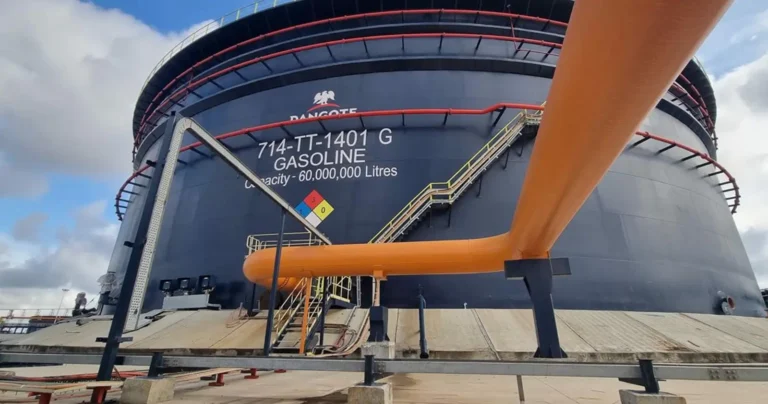
The Managing Director and Chief Executive Officer of Dangote Petroleum Refinery, Mr. David Bird, says fuel prices are unlikely to fall in Nigeria despite the plant operating at full capacity, citing extreme volatility in global oil markets.
Bird told journalists on Monday that the refinery was fully exposed to international commodity markets and that this needed to be widely understood.
“We are fully exposed to the international commodity market. That needs to be widely understood. We purchase, even under the Crude for Naira programme, we purchase Nigerian crude from the Nigerian government at international benchmark-related prices.
“We then pay international freight rates and international insurance rates in order to bring that crude from the terminal to the refinery,” he said.
Bird said that Nigerian crude accounted for about 30 to 35 per cent of the refinery’s crude intake, with the balance sourced on the open market in US dollars — often passing through multiple traders before reaching the refinery, adding further costs.
“All that does is add further costs and premium to purchasing those Nigerian barrels and processing them through Dangote Refinery,” he said.
He said the refinery had processed a wide variety of crudes, predominantly West Texas Intermediate, as well as grades from South America, Central America and West Africa.
Bird acknowledged the burden on consumers, saying the refinery was doing what it could to minimise costs across its supply chain.
“I fully acknowledge the pain that is being suffered. We are seeing that. We are doing what we can to ensure that we minimise costs throughout our supply chain,” he said.
On the scale of market volatility, he said Brent crude, which had been hovering in the mid-$60 range a week earlier, had climbed to $118, while tanker freight costs had surged from about $800,000 to roughly $3.5 million per shipment.
According to the report by Punch newspaper, the Dangote Group said on its official X account that the refinery’s full exposure to international commodity markets extended beyond crude prices to freight rates, insurance and financing costs, with import-dependent countries described as the worst hit as the global oil crisis escalated.
The report added that the talking points during the media chat also noted that domestic refining had given Nigeria supply security, ensuring the country avoided fuel shortages and queues even when global markets were disrupted, and that the refinery did not receive discounted crude under the crude-for-naira arrangement as Nigerian crude was still purchased at international benchmark prices.
The refinery, according to Bird, was operating at its full nameplate capacity of about 650,000 barrels per day, with potential to scale up to around 700,000 barrels per day, and pledged that the plant would continue to meet Nigeria’s fuel demand despite global supply disruptions.
The report recalled that the refinery had on Monday raised the gantry price of petrol to N1,175 per litre from N995 per litre announced on Friday, an increase of N180, or about 18.1 per cent, within three days.
It was the third upward adjustment within a week, with gantry prices having risen from N774 per litre since the previous week.
GIK/APA