





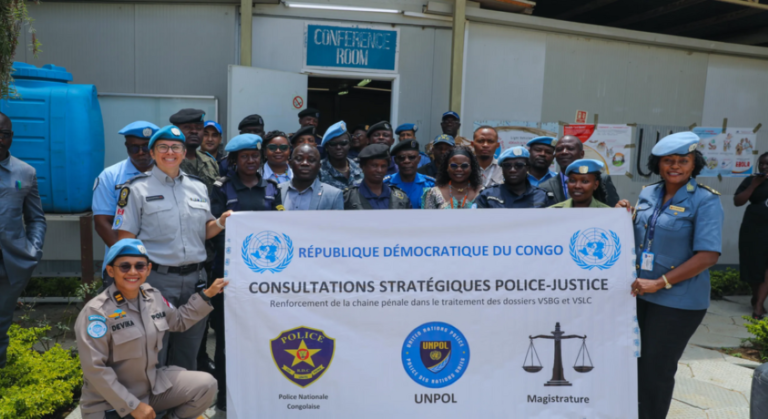
Representatives of the Congolese National Police (PNC), the civil and military judiciary, and other actors in the criminal justice system participated in discussions organised with the support of the United Nations Police (UNPOL/MONUSCO) regarding the prevention of sexual violence and the protection of victims.
The discussions focused in particular on challenges related to investigations, case processing, victim and witness protection, and the shortage of adequately trained personnel.
In Bunia, participants highlighted delays in case processing, difficulties regarding fees charged to litigants despite existing exemptions, and a lack of specialized staff to handle sexual violence
cases.
Material and financial constraints facing investigators also hinder the effectiveness of investigations, particularly when it comes to traveling to remote areas to gather evidence or apprehend suspects.
Victim and witness protection was also identified as a priority, as some survivors may face threats or reprisals during judicial proceedings.
Participants advocated for better coordination among the police, public prosecutors’ offices, civil and military courts, health facilities, and organizations supporting victims.
The issue of out-of-court settlements in sexual violence cases was also examined in light of the applicable legal framework.
The discussions emphasized the need to improve how victims are received and listened to, to guarantee the confidentiality of proceedings, and to strengthen security and protection mechanisms to prevent re-victimization.
At the conclusion of the proceedings, several recommendations were made, including capacity building for criminal justice actors and the creation of specialized chambers to handle sexual violence cases.
Participants also recommended strengthening collaboration among judicial police officers, public prosecutors’ offices, health facilities, and services specializing in gender issues.
Furthermore, they called for judicial institutions to be provided with sufficient material and financial resources to conduct investigations and ensure their presence in remote areas.
Bringing judicial services closer to the population was also advocated to reduce the barriers to accessing justice faced by victims.
The consultations in Bunia and Beni thus aim to strengthen coordination among the various actors in the criminal justice chain and to improve the judicial handling of sexual violence cases in the
DRC.
DM/te/Sf/fss/as/APA