



Senegal’s Minister of the Armed Forces, Yankhoba Dieme, has called for accelerating the operationalization of ECOWAS regional counter-terrorism force and its maritime task force.
He argued that current security threats compel West African states to “strengthen their cooperation and act with greater coherence and determination.”
Speaking at the opening of the 45th ordinary meeting of the ECOWAS Committee of Chiefs of Defence Staff, in Dakar, Senegal on Monday, the minister outlined several challenges including the persistent terrorist threat, the expansion of transnational crime, the proliferation of illicit trafficking, maritime vulnerability, and the emergence of new threats, which he noted are weakening states and directly compromising the security of their populations.
The minister, who spoke on behalf of Senegalese President Bassirou Diomaye Faye, who is the current chair of ECOWAS, stated that the organisation’s strategic directives call for the “operationalization of the regional counter-terrorism force,” the pooling of resources, and the strengthening of the organization’s financial autonomy.
“No isolated response can be effective in the long term,” he insisted, advocating for “a shared strategic vision,” better coordination of national security frameworks, and the development of complementary operational capabilities.
“The time for assessments and statements of intent must give way to a time for decisions and concrete action,” he added.
For his part, Vice Admiral Oumar Wade indicated that the architecture of the counter-terrorism force should be visible by July 2027, in line with the directives of Ecowas leaders.
However, he noted persistent difficulties regarding “funding and by extension, equipment as well as the location of the command post.”
The Senegalese Chief of Staff also called for the establishment of cooperative relations with the countries of the Alliance of Sahel States (AES), rather than opting for “competition or confrontation” with ECOWAS.
“The evil spreads by exploiting divisions,” he warned, also pointing to socio-economic precariousness and religious or intercommunal tensions.
Outlining the meeting’s priorities, he cited the establishment of the counter-terrorism force, the coordination of maritime forces with regional bodies, the creation of cooperation frameworks with neighbouring countries, and the search for solutions to fund the community’s security objectives.
Furthermore, he remarked that the current scale of the counter-terrorism force remains “insufficient given the size of our region and the full scope of its security challenges.”
Commissioner Francesca Piagie Alghali addressed the security and political difficulties facing the region, specifically citing terrorist attacks, unconstitutional changes of government, illegal activities in maritime zones, and transnational organized crime.
She also mentioned the instability in Guinea-Bissau, as well as the challenges surrounding ECOWAS stabilization missions in The Gambia and Guinea-Bissau.
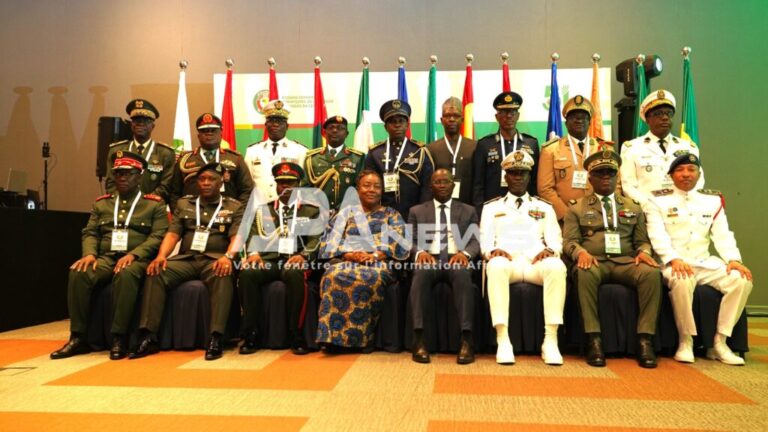
The proceedings of this 45th ordinary meeting will continue until November 18. They are intended to enable the Chiefs of Staff to formulate military and operational proposals for submission to the governing bodies of ECOWAS.
The four-day meeting is being attended by the Chief of General Staff of the Senegalese Armed Forces, Vice Admiral Oumar Wade, and the ECOWAS Commissioner for Political Affairs, Peace and Security, Francesca Piagie Alghali.
AC/Sf/fss/gik/APA