





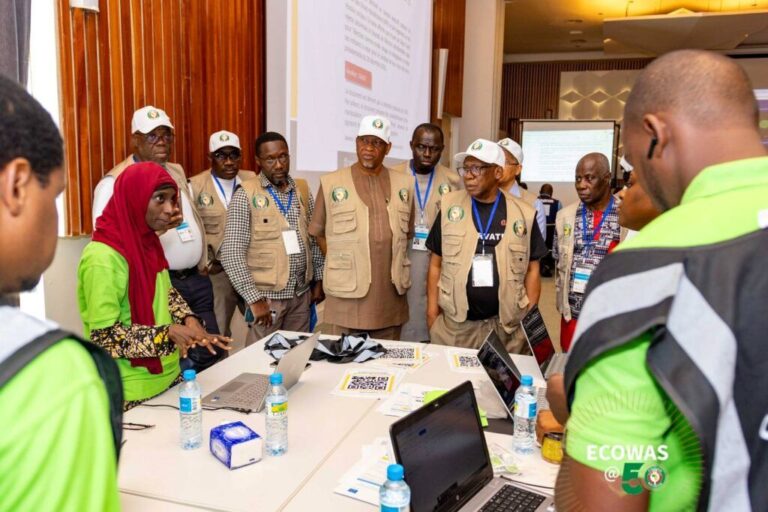
ECOWAS has welcomed the calm atmosphere that attended to Guinea’s presidential election, in spite of what the bloc called minor irregularities.
The Election Observation Mission of the Economic Community of West African States (ECOWAS) commended the generally peaceful and orderly conduct of the December 28, 2025 presidential election in Guinea on Tuesday evening, while pointing to some confusion related to the late
announcement of the extension of voting hours.
In its preliminary statement published on December 30, the Mission, led by the former Assistant Secretary-General of the United Nations Economic Commission for Africa (ECA), Abdoulie Janneh, noted “a relatively satisfactory voter turnout” and “a calm atmosphere from the opening to the closing of the polling stations.”
However, ECOWAS noted that the decision to extend the closing time of the polls from 6:00 p.m. to 7:00 p.m., announced late, caused “some confusion” in several localities.
According to the Mission, this measure, taken by the General Directorate of Elections (DGE), was
announced after vote counting had already begun in several polling stations, notably in Kankan, Labe, Boke, Mamou, and some districts of Conakry.
Observers report that, in some cases, the vote counting process was interrupted after the ballot boxes were sealed in order to comply with the new instruction.
Mamadi Doumbouya in the lead
A few hours after the publication of this statement, the Director General of Elections, Djenabou Touré, announced the provisional results, declaring Mamadi Doumbouya the winner with 86.72% of the vote, or 4,594,262 votes out of 5,297,931 valid votes cast.
The voter turnout was 80.95%, with more than 5.6 million voters out of nearly 6.8 million registered voters. His main opponents finished far behind, with Abdoulaye Yéro Baldé (FRONDEG) obtaining 6.59% of the vote, followed by Faya Millimono of the Liberal Bloc RRD with 2.04%.
The six other candidates did not exceed 2%.
Isolated incidents noted
Despite the generally peaceful nature of the election, the Mission reported several isolated incidents, including the continuation of vote counting in some polling stations despite the order to extend the count, as well as the relocation of ballot boxes in Kerouane, in the Kankan region, for counting to be carried out outside the polling station due to lighting problems.
An election in a sensitive political period
Deployed from December 20, 2025, to January 3, 2026, the ECOWAS Mission mobilized 135 observers spread across the country’s eight administrative regions, covering more than 1,100 polling stations.
The report notes that this presidential election is the first held since the coup of September 5, 2021, and follows the adoption, by a referendum in September 2025, of a new constitution establishing a
seven-year presidential term, renewable once.
ECOWAS emphasises, however, that several major opposition figures did not participate in the election due to constitutional restrictions, disqualifications, or exile, while the temporary suspension of certain political parties has raised questions about the inclusiveness of the electoral process.
A call for calm and legal recourse was issued.
The Director General of Elections called on candidates to prioritise legal recourse and demonstrate political responsibility in order to preserve social peace.
The announced results remain provisional and must be validated by the Supreme Court, which is the only body authorised to proclaim the final results.
ECOWAS reaffirmed its commitment to follow the final stages of the electoral process and to formulate recommendations to strengthen democracy, peace and social cohesion in Guinea.
AC/fss/as/APA