



The Economic Community of West African States (ECOWAS) says that about 32 million community citizens currently risk displacement due to climate crisis, which requires about 294 billion dollars to tackle.
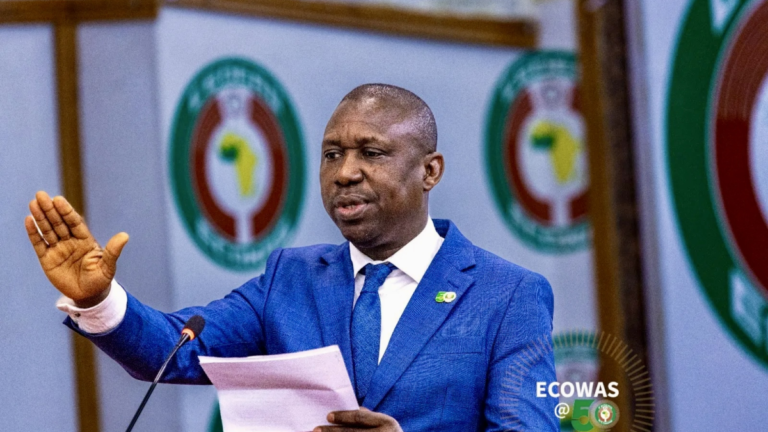
Dr. Kalilou Sylla, ECOWAS Commissioner for Economic Affairs and Agriculture, disclosed this at a regional workshop to validate the framework for the establishment of a West African carbon market platform.
The Commissioner noted that West Africa remained highly vulnerable to climate change, with temperatures projected to rise by between one-and-a-half and three degrees Celsius by 2050.
Sylla, represented by ECOWAS Director, Environment and Natural Resources, Mr. Christophe Deguénon, warned that the devastating impact of climate change could force millions of West African people into internal displacement.
He explained that the validation initiative was designed to address the region’s limited participation in international carbon markets, in spite of its significant potential to generate high-integrity environmental and social carbon credits.
“The ECOWAS Regional Strategy for Access to and Mobilisation of Climate Finance adopted in 2022 estimated the region’s climate financing needs at 294 billion dollars.
“According to World Bank estimates, nearly 32 million West African people could be forced into internal displacement as a result of climate impacts, making collective regional action imperative.
“Climate change constitutes one of the most pressing challenges facing our region today. Indeed, West Africa is among the areas most vulnerable to the effects of climate deregulation,” he said.
He said that regulatory gaps, inadequate technical capacity, tracking systems and certification mechanisms, however, continued to limit the region’s ability to benefit from international carbon markets.
The Commissioner said that ECOWAS began an ambitious regional process in 2024, in line with the ECOWAS Vision 2050 and the African Union’s Agenda 2063, to develop a harmonised framework for a regional carbon market platform.
According to him, the proposed platform is anchored on four principles: transparency, environmental integrity, inclusive governance, and valuation of member states’ climate efforts.
He noted that ECOWAS member states had adopted Nationally Determined Contributions (NDCs) to help keep global temperature increases within the 1.5-degree Celsius target but stressed that achieving the targets would require significant financial resources.
He added that the financing gap had widened following the submission of NDCs 3.0, as member states raised their climate ambitions and the urgency for large-scale climate finance increased.
“The regional strategy also identified the need to establish a regional framework for the operationalisation of Article 6 to help bridge the financing gap.
“This framework aims to leverage the region’s massive potential through carbon markets,” he said.
Sylla also said that over 350 million hectares of agricultural land, major forest blocks, mangroves, and potential for restoring degraded landscapes in West Africa were significant assets capable of generating carbon credits.
“One clear pathway is Article 6 and carbon markets. West Africa has the assets. It has over 350 million hectares of agricultural land, vast forests and mangroves, and huge potential to restore degraded landscapes.
“We can generate high-integrity carbon credits. Yet we remain under-represented in international carbon markets due to gaps in regulation, technical capacity, monitoring, and certification.
“That is why since 2024, ECOWAS has launched a regional process, aligned with Vision 2050 and AU Agenda 2063, to build a harmonized framework for a West African carbon market platform,” he stated.
He said regulatory gaps, inadequate technical capacity, tracking systems, and certification mechanisms, however, continued to limit the region’s ability to benefit from international carbon markets.
He, therefore, urged participants to scrutinize and validate the draft framework to ensure that the proposed platform would be credible, transparent and attractive to investors.
GIK/APA