



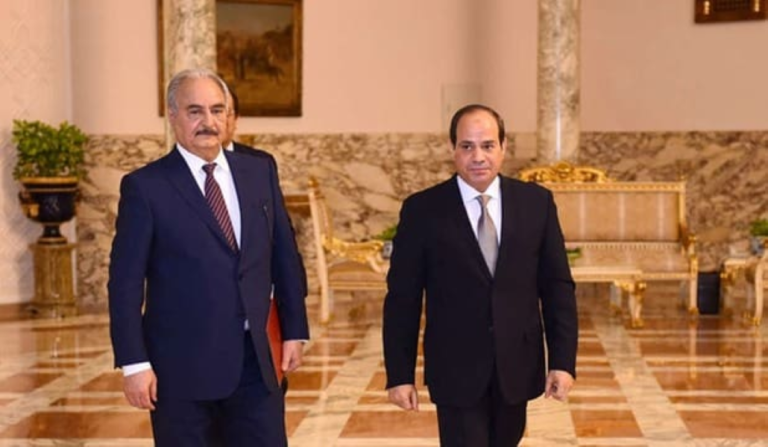
Egyptian President Abdel Fattah Al-Sissi on Wednesday reaffirmed to Marshal Khalifa Haftar Cairo’s support for Libya’s territorial and institutional unity, while calling for presidential and parliamentary elections to be held.
President Al-Sissi received Libyan National Army (LNA) Commander-in-Chief Khalifa Haftar in Egypt for talks on Libya’s political and security situation as well as bilateral relations.
According to a statement from the Egyptian presidency, the head of state reiterated Cairo’s position in favour of preserving Libya’s “unity and territorial integrity” and unifying its institutions.
Al-Sissi notably stressed the need to hold presidential and parliamentary elections as part of a political process capable of consolidating the country’s stability over the long term. Egypt, which shares a lengthy border with Libya, has for several years regarded the stabilisation of its western neighbour as a strategic priority, particularly in terms of security and regional cooperation.
The two officials also discussed prospects for strengthening relations between Cairo and Libya in various fields. The meeting was attended by General Khaled Haftar, LNA chief of staff; Belgacem Haftar, chairman of Libya’s Reconstruction Fund; and Hassan Rashad, head of Egypt’s intelligence services. Cairo said it was committed to helping create the conditions needed for Libya’s economic development and reconstruction.
Khalifa Haftar praised Egypt’s role in efforts to promote regional security and stability. He expressed his willingness to continue coordinating with Cairo to address common challenges and support initiatives aimed at strengthening Libya’s unity, security and development.
The diplomatic engagement comes against a backdrop of fragile security.
The August 10 assassination in Benghazi of the LNA’s military intelligence chief and recent drone attacks on the Zawiya oil complex in western Libya have renewed concerns over a fresh escalation.
These tensions could undermine efforts to reunify state institutions and revive the economy.
They also pose a risk to the oil sector, Libya’s main source of revenue, whose stability remains closely tied to a political and security compromise among the country’s various centres of power.
MK/ak/sf/lb/as/APA