





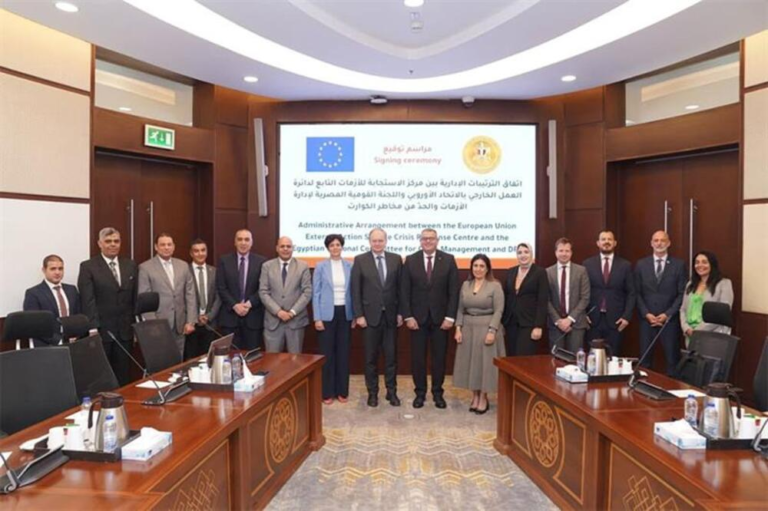
Egypt and the European Union have signed an administrative agreement aimed at strengthening cooperation in crisis management, disaster prevention, and information exchange, further consolidating their comprehensive strategic partnership.
The Egypt–EU agreement was initialed on Sunday by Christian Berger, Director of the Crisis Response Centre of the European External Action Service (EEAS), and Brigadier General Tamer Abdelrahman, Deputy Secretary-General of the Egyptian Cabinet and head of the National Committee for Crisis Management and Disaster Risk Reduction, according to a statement from the EU delegation in Egypt.
The cooperation framework is designed to improve coordination between the two sides in early warning systems, emergency response, and the exchange of information on major risks and crisis situations.
Talks accompanying the signing also addressed rapid response mechanisms for disasters, as well as monitoring of selected international health threats, including the evolution of the Ebola virus.
Both sides also highlighted the role of Egypt’s National Committee for Crisis Management, which coordinates responses to natural disasters, public health emergencies, security incidents, and consular crises involving Egyptian nationals abroad.
According to Egyptian authorities, the committee operates across all 27 governorates and relies on several specialised sub-committees tasked with assessing the humanitarian and security impacts of regional crises, particularly in Gaza, Sudan, and Syria.
The agreement builds on the comprehensive strategic partnership concluded between Egypt and the European Union in March 2024. Its signing comes ahead of the 11th session of the EU–Egypt Association Council, scheduled for 15 June, which is expected to review progress across various areas of bilateral cooperation.
The rapprochement between Cairo and Brussels was reaffirmed in January during a meeting between President Abdel Fattah el-Sisi and Kaja Kallas, where both sides underscored their commitment to political and diplomatic solutions to regional crises.
On the financial side, the European Union has mobilised a total support package of €7.4 billion for Egypt under the strategic partnership. This includes €1 billion already disbursed, €4 billion in approved macro-financial assistance, €1.8 billion in planned investments, and €600 million in grants aimed at supporting economic and institutional reforms.
MK/te/Sf/lb/as/APA