





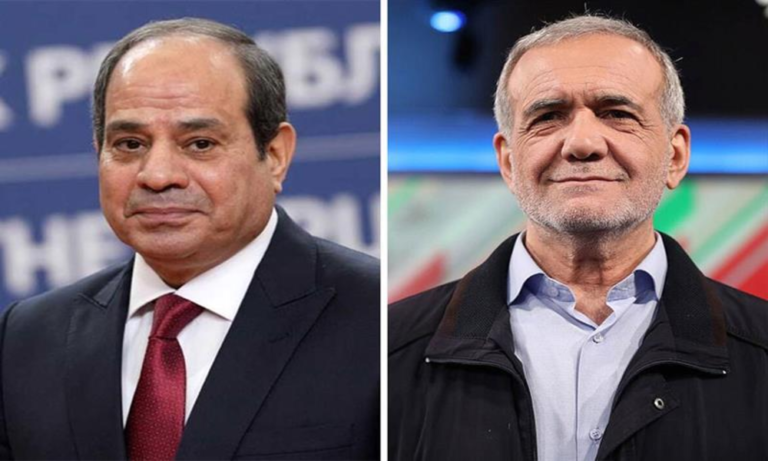
The exchange between Egypt’s Abdel Fattah al-Sissi and his Iranian counterpart Massoud Pezeshkian highlights Cairo’s ambition to position itself as a regional stabilising actor, albeit without decisive leverage in the escalating standoff between Washington and Tehran.
President Abdel Fattah al-Sissi held a phone conversation on Saturday with Pezeshkian, against the backdrop of renewed tensions between the United States and Iran over Tehran’s nuclear programme. According to a statement from the Egyptian presidency, Iran expressed its willingness to maintain “high-level” coordination with Cairo in an effort to help ease tensions in the Middle East.
During the call, the two leaders reviewed the latest developments surrounding Iran’s nuclear file. Al-Sissi conveyed Egypt’s “deep concern” over rising regional tensions and urged all parties to avoid any military escalation.
The Egyptian president stressed that, from Cairo’s perspective, political and diplomatic channels remain the only credible means of preventing a new cycle of instability in a region already weakened by multiple conflicts.
This position, consistently reiterated by Egypt on regional issues, reflects a cautious diplomatic approach aimed at preserving its strategic balances. Cairo seeks to keep communication channels open with all actors, including Iran, while remaining aligned with its traditional partnerships with the United States and Western powers.
This diplomatic balancing act, however, effectively limits Egypt’s real capacity to influence the strategic choices of either Washington or Tehran.
Al-Sissi recalled that he had recently defended this approach in discussions with the US president on the sidelines of the Davos Forum, arguing that only a resumption of dialogue and negotiations could avert a confrontation with far-reaching regional consequences.
While this posture reinforces Egypt’s self-proclaimed role as a mediator, it also underscores the absence of a formal framework or concrete initiative capable of reviving a stalled negotiation process.
For his part, Massoud Pezeshkian praised the “positive role” played by Egypt in de-escalation efforts, thanking Cairo for its initiatives in support of regional security. These remarks, however, appear to fall more within the realm of diplomatic courtesy than that of deep strategic alignment, as relations between Egypt and Iran remain characterised by limited and cautious cooperation.
The exchange comes at a time of mounting military tension in the region, marked by the deployment of additional naval forces to the Middle East on the orders of US President Donald Trump, who has threatened Iran with military action over its nuclear programme. Tehran has, in turn, warned that it would respond forcefully to any joint Israeli-American attack.
MK/AK/Sf/lb/as/APA