





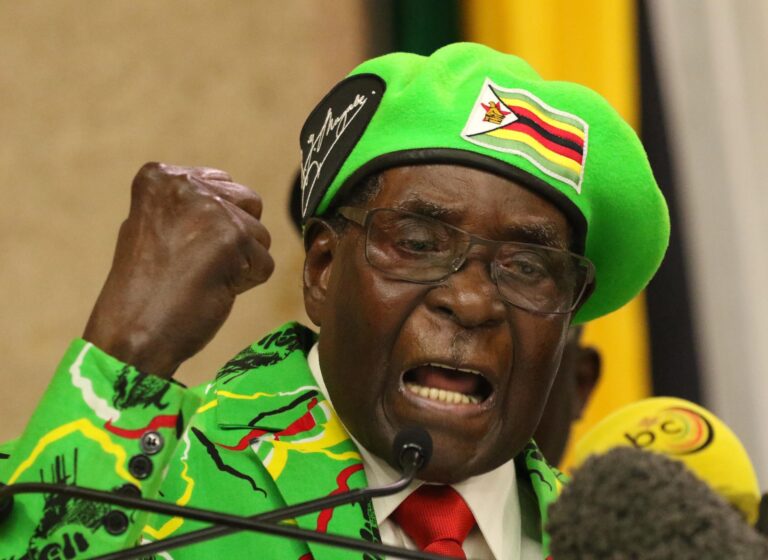
Newly released files linked to disgraced US financier Jeffrey Epstein reveal how Western power brokers viewed African leaders – including Zimbabwe’s former president Robert Mugabe and South Africa’s ex‑president Jacob Zuma – as easily influenced participants in high‑stakes economic and political manoeuvring.
The latest documents, released by the US Department of Justice this week, include email exchanges and FBI testimony suggesting that Epstein and his associates saw African heads of state as ripe targets for manipulation in their financial schemes.
In one 2015 email, Epstein allegedly wrote to Joichi “Joi” Ito, a former director of the Massachusetts Institute of Technology (MIT) Media Lab, saying that they should approach Mugabe with a proposal to help create a new Zimbabwean currency after the collapse of the local dollar, describing the southern African country as a “great petri dish” for experimentation.
In response to the email – which interestingly had the subject “fertile land for exploration” – Ito asked if Epstein was friends with Mugabe, to which he replied: “No, but can easily get his attention. Zimbabwe would be a great petrie dish.”
Another unverified FBI report from 2017 claimed Epstein acted as a wealth manager for both Mugabe and Russian president Vladimir Putin – a claim that, if true, would have violated US sanctions imposed on Mugabe since 2003.
Mugabe, who ruled Zimbabwe for nearly four decades before being removed in a 2017 military‑backed transition, died in 2019.
Zimbabwean officials have dismissed the documents as inaccurate or fabricated, pointing to earlier false claims in the files – including a 2012 email wrongly suggesting Mugabe was dying in Italy.
Zuma, who served as South Africa’s president from 2009 to 2018, also appears in the newly released material.
Emails from 2010 show Epstein helping arrange a private dinner for Zuma at London’s Ritz Hotel, attended by a Russian model described by organisers as adding “glamour” to the event.
In a follow‑up message, one attendee praised the model’s presence and remarked that Zuma was “much more impressive and engaging” than expected.
While the files do not prove wrongdoing by Mugabe or Zuma, they reveal how Western financiers positioned themselves around African leaders, often assuming they could be swayed into questionable ventures.
Analysts say the correspondence reflects a broader pattern in which Africa’s political vulnerabilities are exploited by global elites seeking influence, access, or profit.
The revelations add a new layer to the long‑running Epstein saga, which has continued to reverberate globally since his 2019 death in a New York jail while awaiting trial on sex‑trafficking charges.
Epstein had previously served a 2008 sentence for soliciting sex from a minor, but maintained extensive networks among political, financial, and academic elites long after his conviction.
For African observers, the latest disclosures highlight how Western actors have historically treated African leaders as instruments in geopolitical and financial gamesmanship – reinforcing narratives of corruption while simultaneously exploiting the very systems they criticise.
With both Mugabe and Zuma already associated with domestic corruption controversies, the files risk deepening perceptions of African leadership as susceptible to external influence.
The FBI has not commented on the accuracy of the claims contained in the documents, and several details remain unverified.
But the correspondence offers a rare glimpse into how figures like Epstein viewed Africa: not as an equal partner, but as a landscape where political access could be bought, leveraged or manipulated for private gain.
JN/APA