



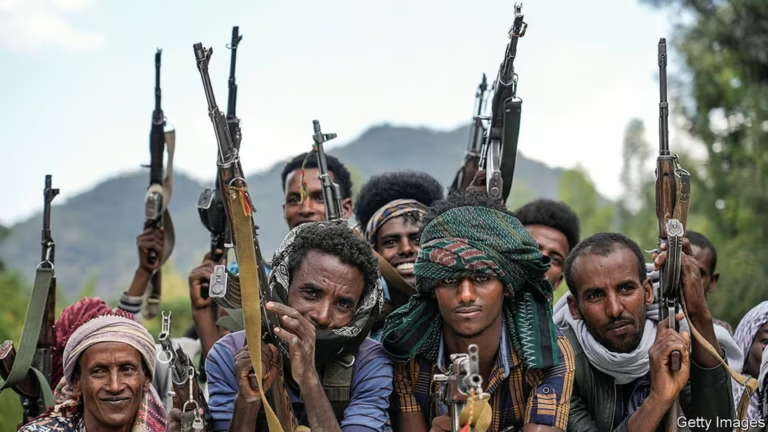
Rebel groups have called for an inclusive political dialogue in Ethiopia with the United Nations (UN) facilitating a credible peace process to end ongoing conflict in the East African country.
In a letter addressed to the UN Secretary-General’s Special Envoy for the Horn of Africa, leaders of the Alliance for Survival and the Amhara Fano National Movement (AFNM) said the UN must involve addressing what they described as existential threats facing the Amhara population and the demands of Ethiopia’s wider communities.
The appeal was made during a phone conversation with Guang Cong on November 14, APA confirmed.
According to information reaching APA, the two leaders namely Zemene Kassie, chairman of AFNM and the Alliance for Survival and Asres Mare, head of public relations and executive member with the Amhara Fano National Movement (AFNM) submitted their remarks in writing following the conversation.
Guang Cong briefed them on the UN’s humanitarian assistance priorities and said he looked forward to returning for further engagements.
Zemene called on the UN to facilitate a dialogue that includes representatives of Ethiopia’s different communities, emphasizing the role of the Alliance for Survival in pursuing a political resolution.
“Ensure that the United Nations plays a constructive role in facilitating a credible peace process that includes the true representatives of all Ethiopian community and fundamentally addresses their demands for survival, justice, and equality and democracy,” he told the envoy.
He said AFNM and the Alliance for Survival remained committed both to defending the survival of their people and to engaging in a political process capable of bringing lasting peace.
Asres, speaking on behalf of AFNM and the Alliance for Survival, said the engagement provided an opportunity to convey what the movement considers the root causes of Ethiopia’s ongoing conflict and the aspirations of the Amhara and Ethiopian people to the international community.
He described AFNM as a consolidated political and military movement that had brought previously dispersed Fano forces under a unified command, constitution and collective leadership. He characterized Fano as a grassroots self-defense force and said the movement was committed to defending the rights of the Amhara population while upholding international humanitarian norms.
“The Amhara people did not take up arms by choice, but out of an unavoidable necessity for survival,” Asres said, alleging that the population had faced systematic identity-based attacks, massacres and mass displacement across different parts of Ethiopia.
He accused the federal government of launching a military campaign in the Amhara region to dismantle regional security structures and forcibly disarm the population, describing Fano’s armed struggle as “strictly a fight for survival.”
The two leaders also called on the UN to press the Ethiopian government to halt airstrikes, drone attacks and artillery shelling affecting civilians and public infrastructure in the Amhara region.
MG/as/APA