





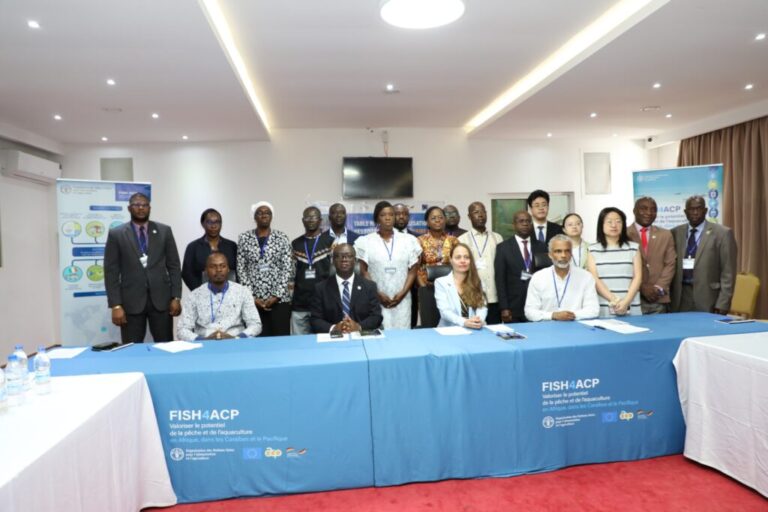
The Food and Agriculture Organization of the United Nations (FAO) organized a crucial roundtable on Tuesday, July 29, 2025, in Abidjan, focusing on resource mobilization for Côte d’Ivoire’s farmed tilapia value chain.
This initiative aims to transform the nation’s aquaculture sector, significantly increasing domestic fish production and reducing reliance on imports.
Joseph Nyemah, FAO Representative in Côte d’Ivoire, stated that the roundtable is a key component of the FISH4ACP program, which focuses on the “Sustainable Development of Fisheries and Aquaculture Value Chains in ACP Countries.” This program is an initiative of the Organization of African, Caribbean, and Pacific States (OACPS), implemented by FAO with funding from the European Union (EU) and the German Federal Ministry for Economic Cooperation and Development (BMZ).
The Ivorian government, through its “Côte d’Ivoire 2030” strategic plan, views aquaculture development, particularly tilapia farming, as a vital instrument for economic growth, food security, job creation, and poverty reduction. Currently, Côte d’Ivoire imports the majority of its consumed tilapia, with 39,500 tons annually, while domestic production averages only 7,700 tons per year (2022 data).
Synergy of actions and financing mechanisms
Nyemah emphasized that the “full involvement of stakeholders along the value chain is essential to ensure the sustainability of actions promoting the development of this sector and to achieve long-term impact.” In this spirit, the FISH4ACP Program initiated Multi-Stakeholder Partnerships (MSPs) to foster cooperation and synergy around common issues. Key themes for these partnerships include improving the accessibility and availability of quality feed for fish farmers, and increasing the local production of quality fry on a regular and profitable basis.
Augustin Millan, President of the Multi-Stakeholder Aquaculture Partnership in Côte d’Ivoire (PM2ACI), noted that this initiative has already led to the validation of a strategy for upgrading the farmed tilapia value chain and the establishment of relationships based on shared objectives.
Danja Bergmann, Deputy Head of Cooperation at the German Embassy in Côte d’Ivoire, reiterated her country’s commitment to promoting sustainable fisheries and artisanal aquaculture, encouraging the processing of fishery products, and strengthening the resilience of fishermen.
The FISH4ACP Program is projected to enable Côte d’Ivoire to increase Nile tilapia production nine-fold by 2031, aiming to meet the entire national demand through a more structured, local, and sustainable value chain that generates jobs. Ouattara Alassane, from the Technical Department of the National Commission of the Global Environment Facility (under the Ivorian Ministry of Finance and Budget), highlighted past support for the sector and confirmed that a second phase of the IPC (Coastal Fisheries Initiative) project, funded at $9 million, will include Mauritania’s participation.
Tidjane Coulibaly, responsible for investments and development for the Aquaculture Transformation Strategy Program, led by the Prime Minister’s Office, indicated the government’s intention to structure the sector with investments designed to reduce fish imports, currently estimated at CFA400 billion. He added that efforts are being made to support young Ivorians with entrepreneurial initiatives through the Aqua Jeunes Initiative, providing access to financing.
Fishing and aquaculture currently account for approximately 3 percent of Côte d’Ivoire’s agricultural GDP. While local production stands at an estimated 92,000 tonnes (with aquaculture contributing a low 8,500 tonnes per year), demand significantly exceeds 733,000 tonnes annually. Djire Foungnigue, administrator of the FISH4ACP Program, noted that Nile tilapia is the most widely farmed species, making up 71 percent of fish production in Côte d’Ivoire, with aquaculture representing “between 4 and 7 percent of national fish production.”
AP/Sf/fss/abj/APA