





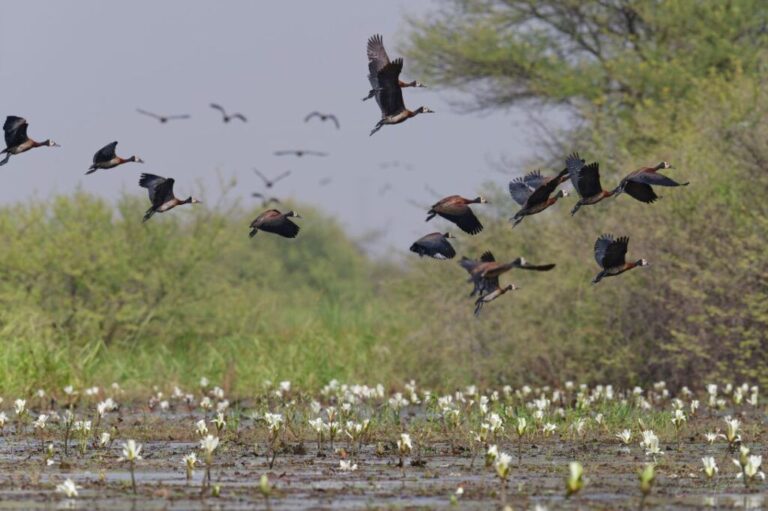
The FAO-led waterbird training aims to strengthen the skills of observers and improve the conservation of wetlands and biodiversity in Africa.
Entitled “Identifying and Counting Waterbirds in North Africa and the Sahel – How and for What Purposes?”, the course will run from September 15, 2026, to May 31, 2027.
more than 1,600 participants from 45 countries, including 27 African countries.
Completely free and taught in French, the course is open to everyone, with a particular focus on participants from North African and Sahelian countries.
Through six interactive modules, learners will learn to identify approximately 210 species of waterbirds, organize census operations, interpret collected data, and join active observer networks in the region.
The program includes expert content, identification sheets, photographs, videos, and self-assessment exercises.
Preserving Sahel Wetlands
The training is developed within the framework of the RESSOURCE+ Project, integrated into the Sustainable Wildlife Management Programme (SWM Programme), coordinated by the FAO in partnership with Tour du Valat and the French Office for Biodiversity.
The RESSOURCE+ Project supports governments and communities in Senegal, Chad, and Mauritania in the preservation of wetlands and waterbirds.
It aims to strengthen international monitoring of waterbirds, promote sustainable hunting levels, and support the development of effective wetland conservation policies in the Sahel.
Co-financed by the French Global Environment Facility and the European Union, the project also involves national authorities, wildlife institutions, non-governmental organizations, and local communities.
Through this initiative, the FAO intends to strengthen local monitoring capacities and contribute to better protection of wetland ecosystems, which are essential to biodiversity and the livelihoods of
many African communities.
TE/Sf/fss/as/APA