



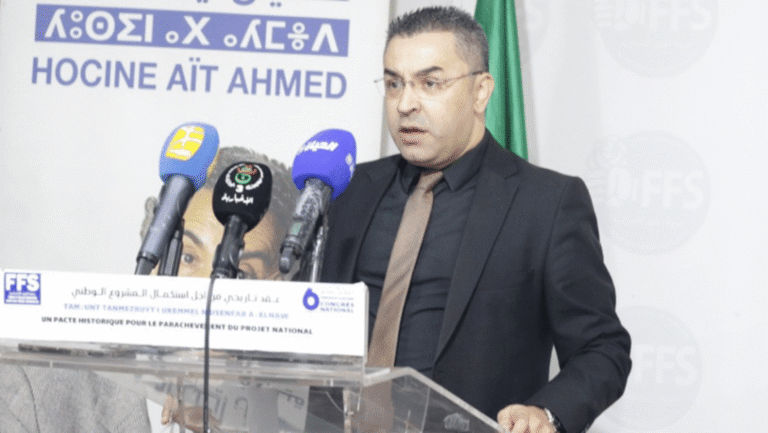
As parliamentary elections approach, Algeria’s Socialist Forces Front (FFS) is attempting to inject vitality into a stagnant political landscape.
The historic opposition party has issued a strong call for a “massive citizen mobilization” to confront the rigid institutional system amid growing popular weariness and distrust of the government.
In a recent ordinary session, the FFS National Council, led by First National Secretary Youcef Aouchiche, urged Algerians to seize the upcoming elections as a “moment of truth.” Aouchiche argued that the vote “can transform the politics of force into the force of politics,” provided that the outcome results in “truly representative” assemblies capable of effectively controlling the executive branch and safeguarding national interests.
The FFS’s appeal functions as a direct warning about the country’s lack of political openness, where institutions remain largely dominated by the presidential and military apparatus.
Youcef Aouchiche emphasized that “Democracy cannot be decreed, it must be built,” advocating for a “profound refounding of the nation-state, based on trust, justice, and citizen participation.” This rhetoric highlights the persistent political impasse: a centralized power structure marginalizing the opposition and fostering a superficial multi-party system.
Azdine Aïssaoui, president of the FFS’s political strategy commission, reinforced this critique, warning that the “persistence of the electoral code in its current form will generate a fragile representation, disconnected from the popular will.” The FFS demands an “inclusive and honest national dialogue,” viewing it not as a concession from the government but as a necessity to rebuild trust between the state and its citizens.
In contrast to the FFS’s focus on mobilization and institutional reform, other established parties are aligning their electoral campaigns with promises of public spending.
The National Democratic Rally (RND), which maintains close ties to the government, held several events where its secretary general adopted a governmental tone. The RND promised substantial “structuring projects” for regions like Batna and Timgad, including a new car factory and a 120-bed hospital, effectively linking electoral support to tangible public investment. Meanwhile, the Movement of Society for Peace (MSP) has focused its recent meetings on institutional topics, such as reviewing the 2026 draft budget law, signaling a more technocratic approach rather than activist mobilization.
MK/ak/ac/Sf/fss/abj/APA