





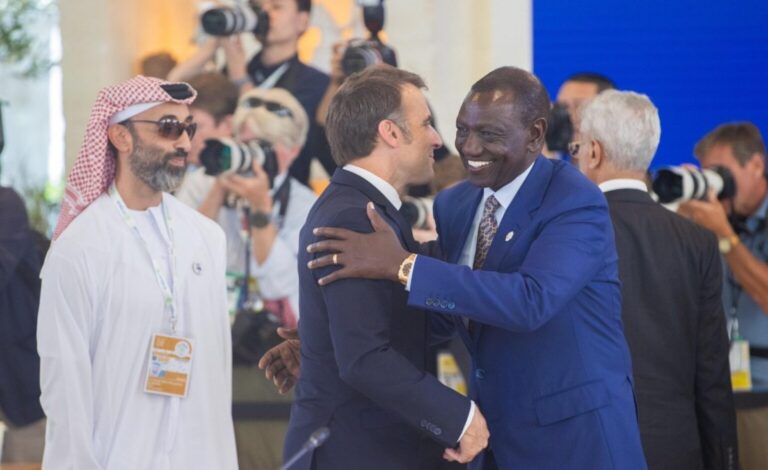
France will not take the displacement of its trade profile in Africa without a fight, plotting its way back into reckoning on a continent where it once commanded a diplomatic, commercial network that was widely coveted y its traditional rivals.
A former colonial power with extensive trade tentacles across Africa, France finds itself increasingly left behind in the race for business supremacy, languishing down the pecking order of trade preferences in African countries which were once its stomping ground.
This is thanks to the relatively new players on the continent, especially China, India and Turkey.
This has grown into a serious concern for those at the Champs-Élysées to the extent that President Emmanuel Macron has weighed in to arrest the slump in France’s stock as a very important trading partner on the continent.
France’s special status in Francophone Africa where its dominance had been incontestable until recently can no longer be taken for granted in terms of its trade value.
Macron last week held a meeting with his ambassadors in the French capital Paris during which he unmistakably lamented emerging economic powers apparently knocking his country from its perch in Africa trade-wise.
He bluntly said if anything French companies and their financial backers should ‘reboot’ and join the current scramble for a gargantuan share of the African business scene, by tempering a new reinvigorated investment with a strategy that could sustain this for as long as necessary.
Research shows that although France’s exports to Africa have risen in absolute terms since 2015, its overall market share has been halved as its international competitors gain more trading footholds across the continent. While the Chinese trade share accounts for an estimated 17% of the African market as its dominated foreign player, France’s had shrunk to a paltry 4.2%, although its 40, 000 companies in Africa belie this negative backstory.
Many African countries have either drifted away from their traditional trading partners in the West including or diversified to other alternative markets representing the new economic powerhouses of China, India, Turkey and Brazil. France like the rest of the West has found itself scrambling for answers to this apparent ‘trade snub’ from its continental partners.
The French leader even lamented that France’s diminished standing with regard to trading in Africa is self-inflicted.
He said his country’s business interests abroad are being harmed by ”excessive regulation and corporate caution” which have led to the once preeminent French market presence on the continent facing an existental crisis.
For over a decade, the trend had witnessed French banks and finance corporations retreating from Africa.
Macron matter-of-factly added: “There is a timidity on the part of many that is no longer understandable and I have asked the minister to really take an in-depth look at this. And basically, let’s bring more and more French groups to Africa.”
He is of the view that for France’s trading strategy to help it gain ground on rivals, extensive partnerships with African economies must be struck, covering whole spheres of trade from finance to the role earmarked for its diaspora.
The competition offered by Chinese companies has grown stiffer for French firms over contracts which are no longer their eclusive preserve especially in Francophone Africa. A case in point is Kenya pulling out of a contract with a French consortium for the building of a highway only to award it to a Chinese company.
The decision to hold the summit in Kenya was agreed by Macron and his Kenyan counterpart William Ruto when the two met on the sidelines of the UN General Assembly in New York last September.
The summit is seen as France breathing new life and vigour into its precarious relations with African countries with an emphasis on mutual respect and benefits that would keep the continent within its orbit.