





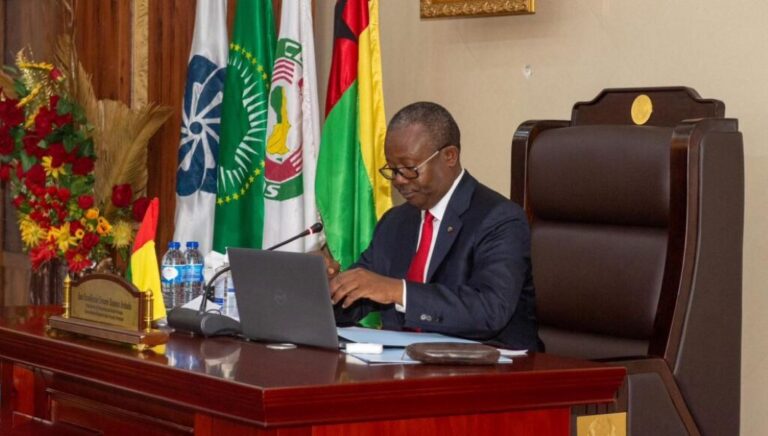
President Umaro Sissoco Embaló has claimed he has been placed under arrest by the army as gunfire is heard around the electoral commission headquarters on Wednesday.
ECOWAS continues to describe Guinea-Bissau’s election as calm and transparent on the eve of the expected announcement of the official results of the presidential polls which both Embalo and his main rival, independent candidate Fernando Dias da Costa are claiming to have won.
President Embaló told Jeune Afrique that he had been detained by elements of the army, along with the Chief of General Staff, General Biaguê Na Ntan, his deputy, General Mamadou Touré, and Interior Minister Botché Candé.
The military has yet to issue any formal statement, deepening the uncertainty following a vote that regional observers nonetheless described as transparent.
The claim comes as heavy gunfire was reported Wednesday morning near the headquarters of the National Electoral Commission (CNE), prompting residents in parts of Bissau to flee.
On Tuesday, the ECOWAS Election Observation Mission (EOM), led by Ambassador Issufu Baba Braimah Kamara, reported a calm, orderly and transparent process, with more than 960,000 voters heading to the polls on 23 November. Polling stations opened on time, political parties were represented, materials were available and security forces adhered to procedures, ensuring a process that met regional standards.
Despite this apparent institutional normalcy, political tensions have escalated.
Fernando Dias da Costa, backed by the PRS and the Terra Ranka Coalition, claimed victory in the first round, saying he had secured favourable results in most regions except Gabú.
He praised the high voter turnout and the adherence to procedures monitored by the public prosecutor’s office. Embaló’s camp also declared victory, adding to the confusion.
The CNE confirmed that voting had proceeded smoothly. Deputy Executive Secretary Idriça Djaló noted that operations unfolded peacefully despite minor logistical challenges that were quickly resolved. He also highlighted strong participation from women and youth, reflecting a growing embrace of civic rights.
The commission reiterated that publishing vote figures before the official announcement—expected no later than 27 November—is strictly prohibited. The presidential race pitted Embaló against eleven contenders, including former president José Mário Vaz, former prime minister Baciro Djá and Dias da Costa.
While ECOWAS has praised a peaceful electoral process, Embaló’s claims of his own arrest—along with senior military figures—have triggered serious concern, standing in stark contrast to the image of an orderly vote reported by regional observers.
AC/lb/as/APA