



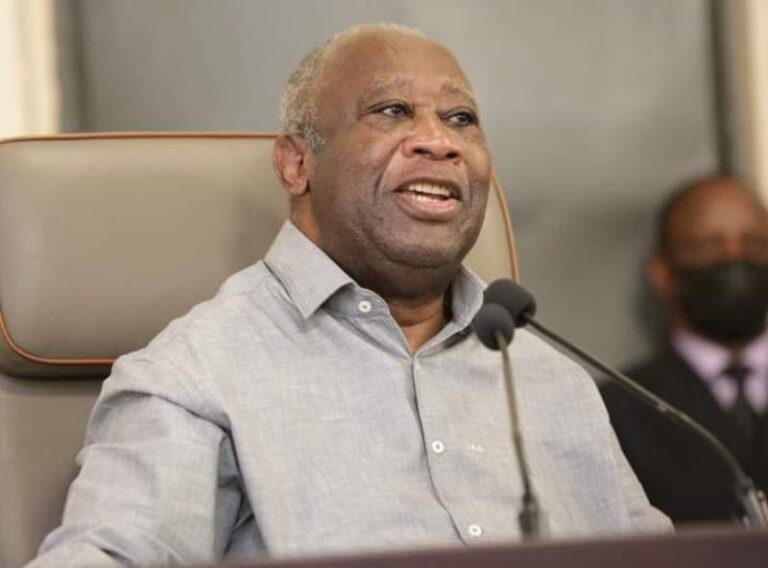
Former Ivorian president and leader of the PPA-CI, Laurent Gbagbo, has published a major statement proposing a new social contract for the nation while denouncing the current government and the erosion of democratic gains.
In a direct indictment, Gbagbo targets the current regime in Côte d’Ivoire, which he claims is the product of a “fourth term.” He paints a bleak picture of the country’s current situation, including the demolition of homes linked to what he considers aggressive urbanization, while also condemning the explosion of poverty, the critical decline of the justice system, and the political imprisonment of those with opposing views. The former head of state strongly criticizes economic growth that he believes benefits only a select few, recalling that he launched the citizen movement “Enough is Enough” to denounce the high cost of living, forced evictions, and mass unemployment.
To address these national emergencies, Laurent Gbagbo is submitting an alternative plan focused on human dignity, asserting that Côte d’Ivoire should no longer be defined solely by the city of Abidjan. This new Social Pact rests on seven structuring commitments. The first pillar is purchasing power, which aims to protect families’ finances from inflation. The second pillar concerns youth and aims to offer real employment opportunities to young people, while the third focuses on women to promote female empowerment and protect the family unit. To complete the pact, the leader of the PPA-CI proposes restoring judicial confidence through fair justice, guaranteeing the fundamental freedoms of every citizen, demanding balanced economic development across all regions, and uniting the nation through genuine reconciliation in the face of past crises.
Reflecting on his tumultuous journey, marked by the 2010-2011 crisis and his years of international detention, Laurent Gbagbo emphasizes the profound meaning of his commitment, noting that his return to the country is not solely aimed at conquering the presidential palace. Addressing criticism about his age, the former president clarifies his current historical role by stating that at this stage of his life, his duty is not to prepare his own future, but to help Côte d’Ivoire prepare its own, adding that while a man and a generation pass away, values must remain. He concludes by calling on the Ivorian people to embrace collective hope, expressing his conviction of a future victory for the sovereignty, democracy, and shared prosperity of his country.
AP/Sf/fss/abj/APA