





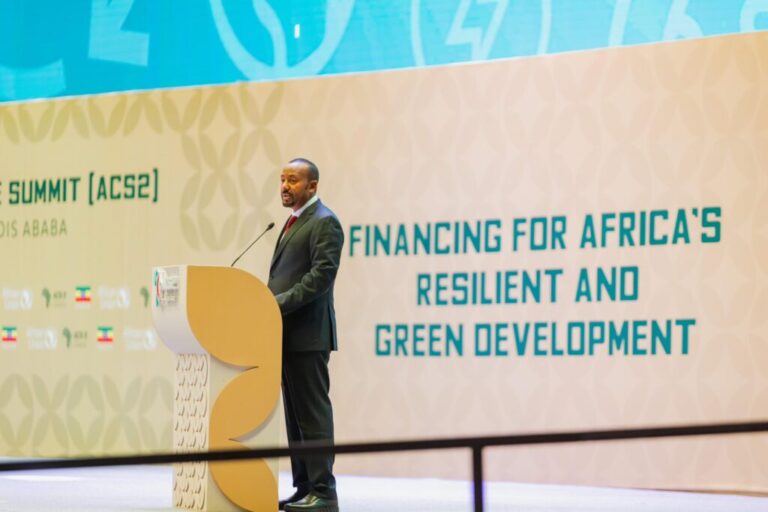
African leaders have concluded their second climate summit with unprecedented financial pledges and a clear signal that the continent is stepping forward as a provider of solutions on the international stage.
The second African Climate Summit (ACS2) marks a turning point in the continent’s climate strategy. With $150 billion in commitments and the launch of major initiatives, Africa aims to position itself as a driving force rather than a passive recipient of international aid—a paradigm shift welcomed, although cautiously, by civil society experts.
“Africa is increasingly asserting itself as a solutions provider, not just a victim of the climate crisis. We are seeing the emergence of a common roadmap focused on investment and innovation, with structuring initiatives such as the Africa Climate Facility,” said Aissatou Diouf, Head of International Policy and Advocacy at the Dakar-based NGO ENDA Énergie.
This shift is backed by ambitious financing. Fifty billion dollars will be mobilized through the new African Climate Innovation Compact (ACIC) and the African Climate Fund (ACF), in addition to $100 billion committed by African financial and development institutions.
For Alexandre Guibert Lette, Executive Director of Teranga Lab, “the summit confirms that Africa is moving from being a demander of aid to a supplier of green investment opportunities. Leaders have clearly sought to position the continent as a climate investment market.”
That ambition was echoed by Ethiopia’s Minister of Planning and Development, Dr. Fitsum. “We are not meeting only to discuss climate change but to shape an African decade of results—a decade where ambition translates into concrete projects,” he said.
He emphasised that ACS2 aims to showcase African climate solutions, mobilise large-scale financing, and transform natural resources, human capital, and innovation ecosystems into shared prosperity.
Opportunities and challenges
Experts, however, remain cautious about implementation. “These mechanisms are promising because they can mobilize resources already available on the continent and reduce our dependence on conditional external loans. It’s a step toward greater autonomy,” Diouf noted.
Wamkele Mene, Secretary General of the African Continental Free Trade Area (AfCFTA), underlined the new approach: “By first mobilizing African capital, we are changing the dynamics. We are showing the world that we are not applicants but investment partners, inviting global capital to join an initiative already underway and de-risked for Africa itself.”
Still, Diouf highlighted three major challenges: transparency in governance, the ability to generate strong and bankable project pipelines, and greater focus on adaptation—still underfunded despite Africa’s call for $579 billion by 2030 for adaptation alone.
Guibert Lette agreed, stressing that financial innovations must be coupled with structural reforms. “Without debt restructuring, targeted public guarantees for resilient infrastructure, and technology transfers, Africa will remain vulnerable,” he said.
Nature-based solutions
The summit also spotlighted nature-based solutions as Africa’s comparative advantage. Initiatives such as the Great Green Wall and Ethiopia’s Green Legacy were cited as examples combining climate, biodiversity, and local development.
But Diouf cautioned that planting millions of trees is not enough without community management, sustained financing, and integration into land and agricultural policies. “We need to move from symbolic initiatives to transformative programs that create jobs and change lives over the long term,” she stressed.
Guibert Lette added that scaling up requires harmonised national and regional frameworks, multi-year results-based financing, stronger local capacity, and market mechanisms such as payments for ecosystem services.
Toward COP30 and beyond
The African Climate Innovation Compact, which aims to deliver 1,000 African solutions by 2030, is seen as a diplomatic lever ahead of COP30 in Brazil. “It sends a strong message: Africa wants to be a driver of climate innovation. This strengthens its political weight,” Diouf explained, while warning that credibility will depend on delivering measurable results.
Lette noted that the compact gives Africa a collective voice: “This boosts its negotiating power with a unified continental message on finance, technology transfer, and climate justice.”
The Addis Ababa Declaration sets out African leaders’ priorities for COP30, calling for high-quality climate finance that does not exacerbate debt, in line with equity and common but differentiated responsibilities.
For observers, the challenge now lies in implementation. “Africa has laid the foundation, but the road ahead is long to turn ambition into tangible outcomes,” Diouf said. Guibert Lette underscored that “the test is credibility. The opportunity is to show Africa as a living laboratory of climate solutions.”
Kenya’s climate envoy, Ali Mohamed, hailed the summit as proof of Africa’s leadership role in the global climate agenda, pointing to the $100 billion commitment by African financial institutions.
International voices echoed that view. “This is the opportunity of our time. Africa has the resources. Africa has the markets. Africa has the people. And Africa has the solutions,” said Selwin Charles Hart, Special Adviser to the UN Secretary-General on Climate Action and Just Transition.
Kate Hampton, CEO of the Children’s Investment Fund Foundation, also welcomed the shift: “Africa is now at the forefront of the global climate agenda. The message is clear: the continent faces immense opportunities for green growth and job creation.” She called for a pragmatic approach focused on economic partnerships and concrete outcomes.
Ethiopian Prime Minister Abiy Ahmed capped the summit by announcing Ethiopia’s bid to host COP32 in 2027. “We propose an African Climate Innovation Compact that unites our universities, research institutes, start-ups, rural communities, and innovators. Ethiopia is proud to present its candidacy to host COP32 in 2027. We invite the world to the African capital of diplomacy and climate ambition,” he declared.
ARD/ac/lb/as/APA