



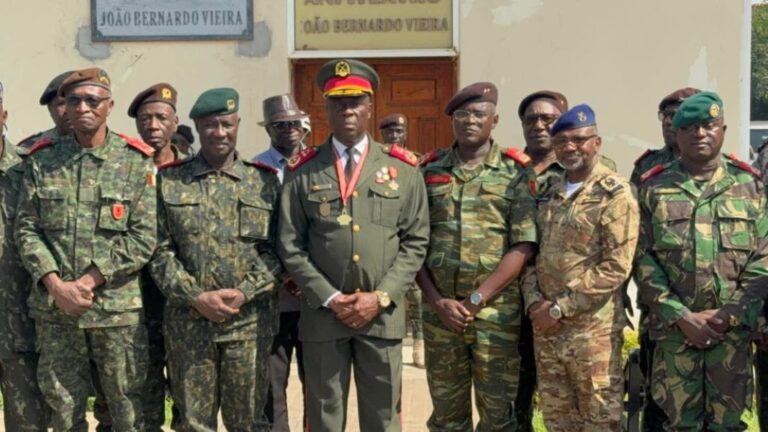
The new mlitary junta in Guinea-Bissau Monday released a so-called Transitional Political Charter,
outlining all public powers which will the interim leaders from running for elective office.
The text establishes a 12-month transitional legal framework, while partially maintaining the constitution.
The High Military Command for the Restoration of National Security and Public Order adopted the charter on Thursday, the day after the breakdown of constitutional order that occurred on November 26.
In the preamble to the charter, filed with the Supreme Court of Justice, the military justifies its intervention by citing the discovery of a “plan to destabilise the country supported by criminal
networks linked to drug trafficking,” incitement to chaos and tribalism, and manipulation of election results.
A clandestine weapons cache intended for the execution of this plan was reportedly discovered, raising fears of civil war. The High Command has removed the country’s president from office and announced the partial suspension of the constitution, the electoral process, and other state institutions.
The charter, however, stipulates the maintenance of fundamental rights, freedoms, and the judiciary.
The transition will be led by four bodies: A transitional president appointed by the High Military Command; the High Command itself as the supreme body for political guidance; a 65-member National Transitional Council exercising legislative power; and a transitional government headed by a prime minister.
The transition period is set at 12 months, with elections to be held at least 90 days after their date is set. The document, however, effectively blocks any political ambitions of the transitional leaders by prohibiting its president and the prime minister from running in the post-transition elections.
An amnesty law has been promised for acts committed on November 26, 2025. In case of conflict between the constitution and the charter, the latter will prevail.
The coup occurred on November 26, just hours ahead of the announcement of the results of presidential election held three days earlier.
The military, which established a High Military Command for the restoration of national security and public order, arrested President Embalo. He was then flown to Senegal, from where he traveled to the Republic of Congo, then to Morocco.
Several political and military officials were also arrested, including former prime minister Domingos Simoes Pereira.
General Horta N’Tam was sworn in as president of the transitional government for a maximum of one year.
He promised to combat drug trafficking “vigorously,” which he accused of attempting to “hijack
Guinean democracy.”
The former army chief of staff appointed a government headed by Ilidio Vieira Te, the last finance minister of the ousted president.
AC/Sf/fss/as/APA