





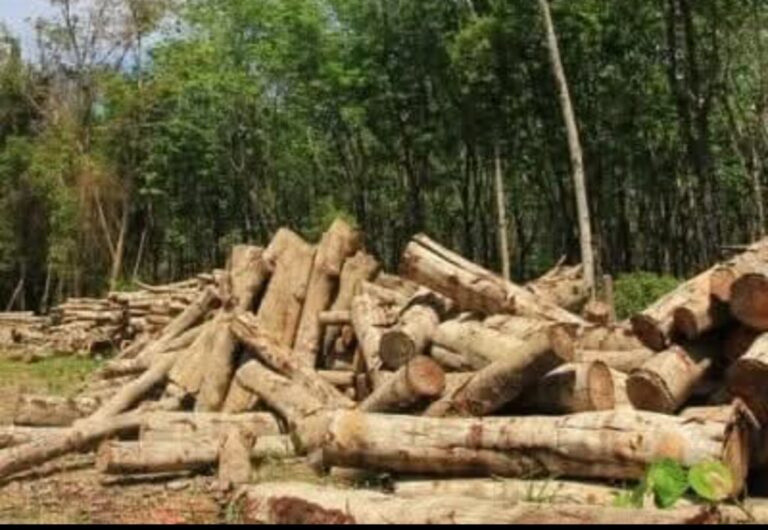
The Guinean government has announced a temporary suspension of all logging, transport, and importation of wood from 7 July to 30 September 2025 as part of a “biological rest” period aimed at preserving the country’s forest resources.
The decision, issued Tuesday by the Ministry of Environment and Sustainable Development, applies nationwide and covers all wood-related activities, including the trade of timber planks.
The measure is intended to curb over-exploitation and promote sustainable forest management.
It is based on Law L/2017/060/AN of 12 December 2017 and Ministerial Decree A/2016/5059/MEFF of 5 September 2016, particularly articles 42, 59, and 81 relating to forest resource conservation.
The ministry urged strict cooperation from all stakeholders—including local authorities, environmental gendarmerie, customs services, and the Guinean Office of Wood—to ensure full compliance.
Violators will face legal sanctions. The official date for the resumption of forestry activities will be announced at a later time.
This annual so-called biological rest period coincides with the rainy season and comes amid a sharp decline in Guinea’s forest cover. According to Global Forest Watch (2024), Guinea lost about 149,000 hectares of natural forest between 2001 and 2024—a 6.7% decrease from its 2000 baseline. In 2023 alone, over 9,200 hectares were deforested, mainly in the forested regions of southeastern Guinea.
A 2020 FAO report estimated Guinea’s forest cover at 6.7 million hectares, or 28% of national land area—down steadily since the 1990s.
Guinea Conakry is home to part of the Upper Guinean forests of West Africa, one of the world’s 36 biodiversity hotspots identified by Conservation International.
These ecosystems, stretching from the Fouta Djallon highlands to the Ziama and Mount Nimba reserves, are increasingly threatened by deforestation, slash-and-burn agriculture, bushfires, and mining.
Several environmental NGOs have welcomed the moratorium, saying if effectively enforced, it could support ecosystem restoration and enhance the resilience of rural communities.
However, they also urged the government to introduce alternative income-generating options for communities dependent on forest exploitation.
MB/ac/sf/lb/as/APA