





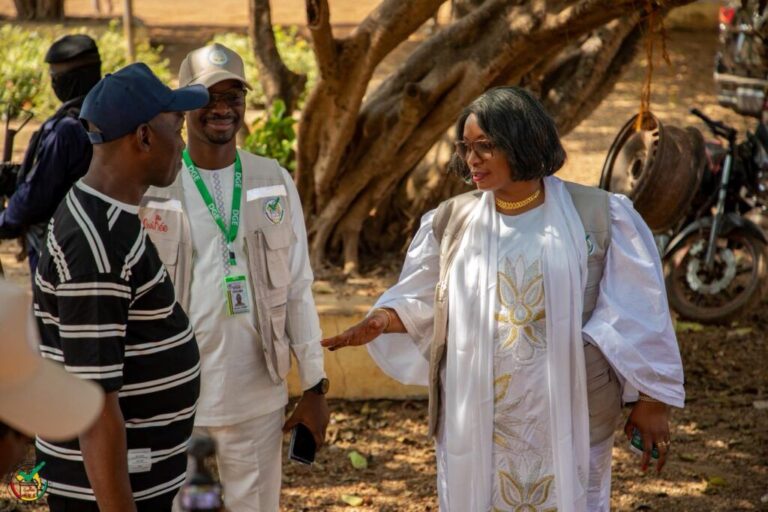
On Sunday evening, Guinea’s Director General of Elections (DGE), Djenabou Toure, praised the successful organisation of the election, marked by a strong voter turnout, a peaceful atmosphere, and adherence to the electoral calendar, announcing a provisional participation rate of approximately 85%.
Director General of Elections (DGE), Djenabou Toure, expressed her “pride” on Sunday following the first round of the Guinean presidential election held on December 28, commending the successful
organisation and strong popular enthusiasm across the country.
Speaking during a special broadcast of the DGE, Ms. Toure stated that her state of mind was above all “a feeling of pride: pride in being Guinean, in being a woman, and in having led the organisation of this presidential election.”
She asserted that the DGE had met the expectations of the Guinean people by respecting the electoral calendar established by presidential decree, putting an end to the postponements of the election observed in the past.
According to the head of the election management body, the process unfolded peacefully thanks to an inclusive approach. The election mobilised 6,768,458 voters, distributed across 23,662 polling stations in 16,722 centres, with the active participation of civil society, youth, women, people with disabilities, political parties, and the media.
Ms. Toure also commended the contribution of the defense and security forces, who were committed to securing the electoral process “well before the campaign,” as well as the logistical advancements, notably the construction of regional warehouses for the secure storage of
electoral materials.
Regarding the presidential campaign, Guinea’s election chief emphasised its “civilised and rule-abiding” nature, noting the absence of major incidents.
She highlighted the role of the High Authority for Communication (HAC) in ensuring the fair regulation of speaking time and the oversight of support movements.
Regarding voter turnout, Ms. Toure announced that at the close of polling stations, the participation rate was close to 85%, a “record” which, according to her, reflects the democratic maturity of Guineans.
She specified that all 378 administrative centralization commissions had begun processing the results, both manually and electronically, in Guinea and abroad. Partial results, by prefecture, are expected to be published starting this Monday, as the centralisation process is completed, before the announcement of results from constituencies in Africa, Europe, the Americas, and Asia.
The presidential election of December 28th featured nine candidates, including the head of Guinea’s
transitional government, Mamadi Doumbouya.
Other contenders include Abdoulaye Yero Balde of the Democratic Front of Guinea (FRONDEG), Makale Camara of the Front for National Alliance (FAN), the only woman in the running, and Faya Lansana Millimouno of the Liberal Bloc (BL).
The list also includes Ibrahima Abe Sylla, Abdoulaye Kourouma, Mohamed Nabe, Elhadj Bouna Keita, and Mohamed Cherif Tounkara.
The election was marked by the absence of several major figures from the traditional opposition, who were excluded from the electoral process or are in exile, a situation that fuels debates about the inclusiveness of the election.
AC/Sf/fss/as/APA