





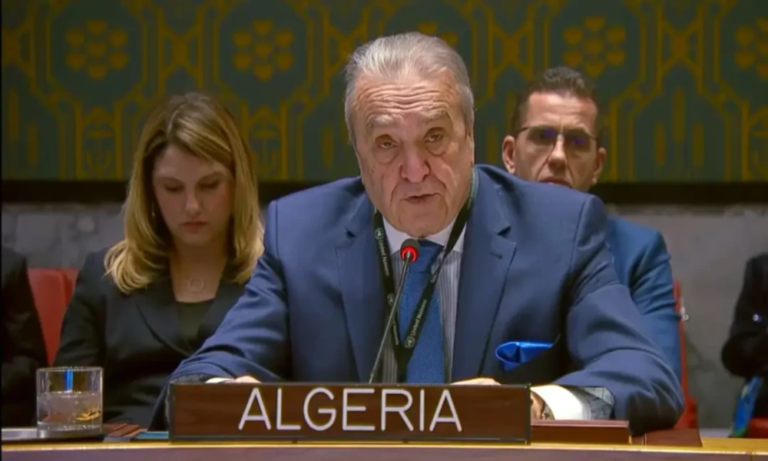
As a non-permanent member of the UN Security Council for two years, Algeria has promoted a diplomacy of principles and advocacy, but its effectiveness remains debatable.
Algeria concluded its term as a non-permanent member with a flurry of diplomatic activity, marked by a strong media presence and a consistent discourse on “just causes.”
According to official statements, this period allowed Algiers to occupy a central position on Palestinian, Sahrawi, and African issues, particularly during its rotating presidency of the UN body.
Following the guidelines set by President Abdelmadjid Tebboune, the Algerian Permanent Mission to the United Nations increased its interventions and requests for emergency meetings, especially regarding the war in Gaza.
Algiers claims a leading role in denouncing the humanitarian crisis and advocating for an immediate ceasefire, while also highlighting the restrictions imposed on UNRWA’s operations. These positions are consistent with a long-standing diplomatic tradition, but their real impact on UN Security Council decisions remains limited, given the absence of binding resolutions reflecting these stances.
In Africa and the Arab world, Algeria has also sought to establish itself as the voice of the A3+ group, asserting its commitment to dialogue on crises as diverse as those in Sudan, Libya, Syria, Yemen, and the Democratic Republic of Congo.
Algerian diplomacy emphasises its commitment to a “Libyan-led” solution and the partial recovery of frozen assets of the Libyan Investment Authority.
Here again, these advances remain framed by collective UN mechanisms, thus diminishing the impact of purely national action.
During Algeria’s month-long presidency of the Security Council, Permanent Representative Amar Bendjama was omnipresent in the debates, issuing numerous statements and initiatives. This increased visibility fueled the narrative of an “indispensable” Algeria on the Security Council, without, however, altering the structural balance of an institution dominated by the permanent members and their vetoes.
Beyond the conflict issues, Algiers claims to have contributed to the discussion on reforming multilateralism and the international economic order. This ambitious discourse, a recurring theme in Algerian diplomatic rhetoric, is hampered by the lack of operational proposals translated into projects or lasting alliances. At the end of these two years, the assessment made by the Algerian authorities highlights doctrinal fidelity and consistency of tone. It nevertheless leaves open the central question of effectiveness: between diplomatic activism, ideological posturing, and tangible results, the Algerian mandate on the Security Council appears primarily as a political showcase, rather than a decisive lever of international influence.
MK/ak/ac/fss/as/APA