





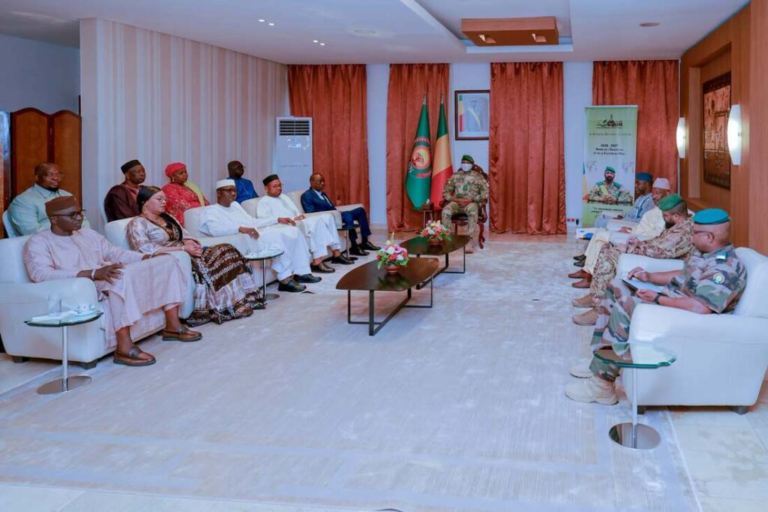
Malian Transition President Assimi Goïta has officially received the final report of the National Forum on Justice from Minister of Justice and Human Rights Mamoudou Kassogué.
The comprehensive document outlines 218 finalized recommendations intended to overhaul the nation’s judicial system and rebuild public faith following nationwide consultations that began in 2023. Originally gathered from 413 initial proposals submitted by roughly 500 participants across regional assemblies and the main forum in Bamako, the proposals focus on professional training, magistrate evaluations, digitalized court records, internal oversight, and prison conditions.
The reform blueprint arrives as access to justice in Mali remains strained by high legal costs, long processing delays, and widespread concerns over judicial inequality. An Afrobarometer survey released in February 2026 revealed that 56 percent of Malians doubted ordinary citizens could achieve justice through the courts, while 57 percent reported that individuals are frequently treated unequally under the law. Despite these persistent hurdles, institutional trust has shown positive momentum. Public trust in courts rose to 52 percent—a 17 percentage point increase since 2020—while perceptions of judicial corruption fell by 25 percentage points to 38 percent.
Efforts to modernize the legal framework are already under way, backed by a new Penal Code and Criminal Procedure Code enacted in December 2024. These legislative changes introduced permanent criminal chambers, mandatory reasoned decisions, liberty and detention panels, and alternatives to incarceration. However, rights organizations note that operationalizing these changes depends heavily on funding, capacity building, and regulatory implementation. To support this transition, the government’s ten-year justice sector plan projects funding needs to grow from CFAF 56.03 billion in 2025 to over CFAF 110 billion by 2029.
The 218 recommendations will now be incorporated into the broader 2026–2035 Ten-Year Justice Sector Development Programme. While President Goïta has issued directives to execute the forum’s conclusions, the presidency has yet to outline specific priority actions, execution timelines, or dedicated budget allocations. Coming 27 years after Mali’s last National Forum on Justice in 1999, and with the country ranked 126th out of 143 nations on the 2025 World Justice Project Rule of Law Index, the ultimate success of the initiative will depend on turning structural recommendations into tangible outcomes within courts and detention facilities nationwide.
MD/te/Sf/lb/abj/APA