



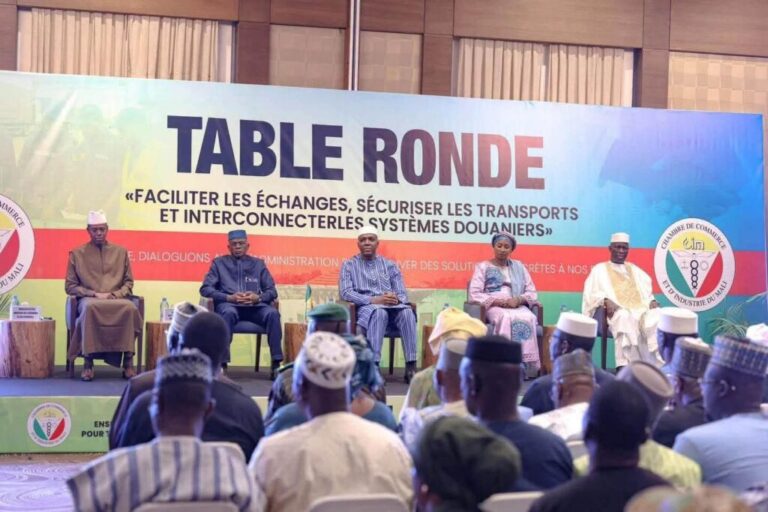
The Malian government and private sector stakeholders have launched high-level consultations in Bamako aimed at simplifying foreign trade procedures and reducing the processing times and costs linked to import, export, and transit operations.
Chaired on Thursday by Prime Minister Major General Abdoulaye Maïga, the roundtable was initiated by the Chamber of Commerce and Industry of Mali (CCIM) and brought together government representatives, technical agencies, consular chambers, and private operators to address trade formalities, transport security, and customs administrative interconnections.
The initiative follows a preliminary July 31 working session with a World Bank mission, Customs authorities, and the Directorate General for Trade, Consumer Affairs, and Competition focused on fulfilling the World Trade Organization (WTO) Trade Facilitation Agreement. The economic stakes are substantial for landlocked Mali, which recorded over CFA2.15 trillion in total trade in the fourth quarter of 2025 alone, yielding a CFA418.9 billion trade surplus driven heavily by gold exports. Efficient border operations are vital to preventing supply chain disruptions and managing import costs on machinery, fuel, and food supplies.
Trade processing also remains central to state finances, as the Directorate General of Customs collected CFA284.447 billion in the first quarter of 2026 toward an annual target of CFA975 billion. While Mali has implemented 83.6 percent of its WTO Trade Facilitation Agreement commitments, complete fulfillment requires finalizing remaining measures through 2030 and resolving information gaps regarding the single-window system and customs brokerage. The upcoming phase of reforms will focus on consolidating or removing redundant administrative steps, establishing an implementation timeline, and achieving measurable reductions in logistics costs while safeguarding public revenues.
MD/te/Sf/lb/abj/APA