



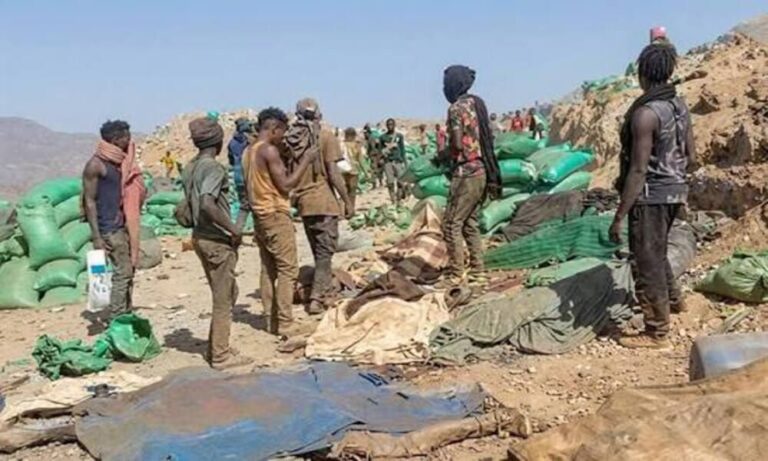
The war in Sudan has turned the Egyptian-Sudanese border into a zone of tension, where clandestine gold mining fuels illicit trafficking and security risks.
In response, Cairo is stepping up its control operations while seeking to maintain its relationship
with Khartoum.
Since the outbreak of the civil war in 2023 between the Sudanese Armed Forces (SAF) and the paramilitary Rapid Support Forces (RSF), the 1,276-kilometer border separating Egypt from its neighbour, Sudan, has undergone a fundamental shift.
The arid reaches of the Eastern Desert – a vast expanse between the Nile Valley and the Red Sea,
characterized by rugged, mountainous terrain – have become the setting for an informal gold rush, turning the area into a hub for clandestine movement and, increasingly, confrontation.
For Cairo, the primary concern is security. On the evening of Monday, October 12, a spokesperson for the armed forces announced “the third phase of a large-scale campaign aimed at combating illegal gold prospecting activities in the Eastern Desert.”
The statement noted that the armed forces and civilian police are continuing the operation, having first “dropped warning leaflets addressed to the criminal elements present in the area.”
Cairo maintains the legitimacy of its territorial control operations, asserting that the campaign is intended to “enforce the full sovereignty of the Egyptian state within its borders and to protect
its national resources and wealth,” while explicitly denying any violation of Sudanese territory.
According to Sudanese media, a strike reportedly targeted an artisanal gold mining site on October 10. This incident highlights the extreme volatility of the situation, though it is not without precedent.
Last June, a large-scale operation was carried out “against several criminal hubs exploited by criminal organizations and networks to conduct illegal activities,” a military statement noted at the time.
The text cited drug and arms trafficking, illegal gold mining, and clandestine immigration. This initial wave resulted in the arrest of 87 Egyptians and 136 foreign nationals – according to official figures – as well as the seizure of cash and weapons.
From Cairo’s perspective, this represents a “direct threat to national security, in addition to its negative impacts on economic stability, the investment climate, and sustainable development efforts” – all the more so because the security vacuum in Sudan facilitates the infiltration of armed criminal elements.
Deprived of its oil revenues, the Sudanese economy has turned to the gold trade to finance the war and the warring factions.
And with a total absence of Sudanese administrative structures on the southern side of the Egyptian border, civilians have found an opportunity there.
General Abdel Fattah al-Burhan, chairman of the Sudanese Sovereignty Council and an ally of Egypt, has announced the creation of a “commission composed of representatives from the public prosecutor’s office, the judiciary, and security agencies” to investigate the circumstances of the incident.
MK/AK/Sf/fss/as/APA