





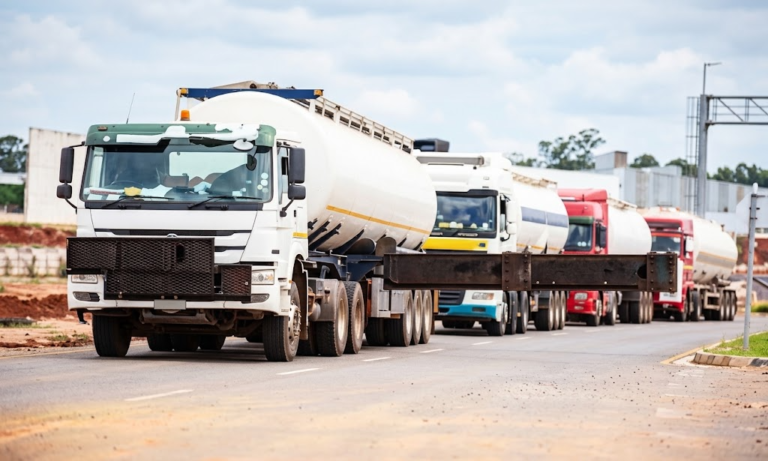
Mali received 66.6 million litres of petroleum products between August 3 and 16, 2026, transported by 1,430 fuel tankers.
The deliveries point to relatively steady supply flows, while a diesel shortage persists in Bandiagara and global oil prices resume their upward trend.
Between August 3 and 9, 37 operators delivered 710 tankers carrying 33.749 million litres, according to data presented on Thursday by Mali’s Ministry of Industry and Trade. The following week, 34 operators received 720 tankers carrying 32.817 million litres.
Together, the two periods accounted for exactly 1,430 tankers and 66,566,308 litres, an average of 4.75 million litres per day. Each tanker carried approximately 46,550 litres.
Behind this apparent stability, however, the two weeks showed contrasting trends. The number of tankers increased by 1.4%, while the volume delivered fell by 2.8%, or 931,692 litres. The average load therefore dropped from 47,534 to 45,580 litres per tanker, a decline of just over 4%.
The variation may be attributable to vehicle capacity, partial loads or the composition of the products transported. The ministry did not provide a breakdown of petrol, diesel, fuel oil, Jet A1 and butane gas for the two periods, limiting the interpretation of the differences.
By comparison, 698 tankers carrying 32.501 million litres were recorded between July 27 and August 2. The three available reports therefore put weekly deliveries within a range of 32.5 million to 33.7 million litres.
The previous figures, however, mainly covered Bamako, whereas the latest report is presented at the national level.
In Bandiagara, in central Mali, a diesel shortage is still being reported despite the volumes received. The ministry said other regions outside the capital remain generally supplied, without specifying how long the shortage has lasted, how many stations are affected or what quantities are required to resolve it.
The situation shows that volumes entering the country provide only a partial picture of actual fuel availability.
Deliveries to the regions, truck turnaround times, storage capacity and distribution to service stations also determine market conditions.
The authorities attribute the improvement in supply flows to enhanced security along major roads, particularly the Bamako-Dakar corridor. The Military Engineering Corps is involved in improving and securing the route, which is used to transport goods from Senegal.
The ministry also reported a decline in fuel smuggling, without providing comparative figures.
The August 20 meeting took place against a backdrop of rising global oil prices. Brent crude closed Thursday at $93.78 a barrel, up 2.4%, reaching its highest level since July 24.
In its projections published on August 11, the US Energy Information Administration estimated that the average price could reach around $85 a barrel in the third quarter of 2026, partly due to supply disruptions affecting the Middle East.
In Mali, the latest price ceilings announced by the Malian Petroleum Products Office came into effect on March 28. The price of petrol rose from 775 to 875 CFA francs per litre, an increase of nearly 13%, while diesel rose from 725 to 940 CFA francs, an increase of about 30%.
As a landlocked country with no domestic oil production, Mali relies on imports to fuel transport, electricity generation, mining, telecommunications and part of its industrial activity.
In 2024, its imports of petroleum products reached 2.665 million cubic metres, equivalent to 2.67 billion litres, compared with 2.622 million cubic metres in 2023. This represented a 1.66% increase.
Imports of butane gas also rose from 13,847 to 15,838 tonnes, an increase of 14.38% year-on-year.
In April 2026, the government established a national strategic reserve designed to cover 45 days of consumption of petrol, diesel, Jet A1 and butane. The mechanism is intended to shield the economy from logistical disruptions and sharp fluctuations in international prices.
However, the report presented Thursday did not specify the volume already accumulated in the reserve or the number of days of consumption currently available. The 66.6 million litres received therefore confirm the continuity of recent deliveries, while the operationalisation of the strategic reserve and reliable supply to the regions remain the key indicators to monitor.
MD/Sf/lb/gik/APA