





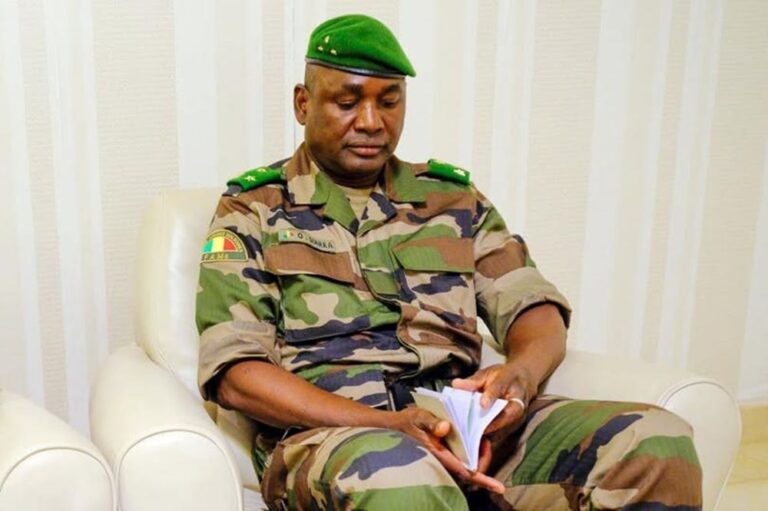
Malian troops have been deployed to Kidal following confirmation of the death ofdefense minister, General Sadio Camara, killed in the coordinated attacks of April 25.
The Chief of the General Staff of the Armed Forces, General Oumar Diarra, asserted Sunday evening
that the Malian Armed Forces (FAMa) maintain the initiative on the ground, with more than 200 combatants neutralised and a tactical repositioning underway in the Kidal region.
Camara, died from the coordinated attacks by insurgents that targeted several locations across the country on Saturday, Malian national television confirmed Sunday in an official statement from the
transitional government.
According to the statement, a car rigged with a bomb driven by a suicide bomber targeted the minister’s residence in Kati, near Bamako, during the incursions that occurred in the morning.
Sadio Camara reportedly engaged in exchanges with the attackers and managed to neutralise some
of them before being seriously wounded. Taken to the hospital after intense clashes, he ultimately succumbed to his injuries.
The statement also specifies that the collapse of his residence caused other casualties, as well as the destruction of a nearby mosque, resulting in the deaths of several worshippers inside.
A key figure in the transition since 2021 and close to the President of the transition, Assimi Goita, Sadio Camara was considered one of the main architects of the security and diplomatic restructuring of Bamako, notably the strategic rapprochement with Moscow and the deployment of Africa Corps alongside the Malian Armed Forces.
On Sunday evening, the Chief of the General Staff of the Armed Forces, General Oumar Diarra, addressed the scale of the offensive, stating that seven localities, including Kidal, Gao, Mopti, Sévaré, Bamako, and Kati, had been simultaneously targeted by “complex and coordinated” attacks.
According to him, these offensives are part of “a destabilisation plan coordinated by internal and external actors” aimed at creating a climate of permanent insecurity in the country.
He specified that the attackers used suicide vehicles, improvised explosive devices, suicide drones, indirect fire, and direct attacks against military positions.
The high command asserts that the Malian Armed Forces’ (FAMa) response has “routed the enemy,” with more than 200 combatants neutralised so far, while mopping-up operations continue in several areas.
Regarding Kidal, General Diarra acknowledged a unique situation, explaining that the army is “readjusting its deployment” by repositioning forces in the town of Anefis, while maintaining its
positions in the region. “We are staying in the Kidal region,” he insisted, presenting this maneuver as a choice of operational flexibility intended to strengthen the effectiveness of missions and the protection of the population.
For its part, the Russian Africa Corps, deployed alongside the Malian Armed Forces (FAMa), announced that it had left the city of Kidal with the Malian army, stating that this withdrawal was carried out as part of a joint decision with the Malian authorities.
The wounded and heavy equipment were reportedly evacuated as a priority.
According to several concurring sources, the attacks began on Saturday around 5:30 a.m. with simultaneous assaults claimed by the Group for the Support of Islam and Muslims (JNIM), affiliated with Al-Qaeda, as well as by the Front for the Liberation of Azawad (FLA), the new name of the former CMA.
The armed groups claimed to have targeted, among other things, the presidential residence, the Ministry of Defense headquarters, and Modibo Keita International Airport in Bamako, as well as military positions in Kati, Gao, Kidal, and Sevare. The FLA also claims to control the city of Kidal.
In a statement Saturday evening, the transitional government described the attacks as “complex and coordinated,” reporting 16 wounded among civilians and military personnel, while assuring that “the situation is completely under control.”
Faced with the deteriorating security situation, a 72-hour curfew was imposed in Bamako starting Saturday evening, while Modibo Keïta International Airport remained closed on Sunday.
The Economic Community of West African States (ECOWAS), the African Union (AU), as well as Senegal, Mauritania, and Benin, condemned the attacks and expressed their solidarity with the Malian authorities.
Transition head, Assimi Goita, the government, and all the Defense and Security Forces paid tribute to General Sadio Camara, praising his fighting spirit, fearlessness, professionalism, and commitment.
By presidential decree, he will be given a state funeral.
His death constitutes, at this stage, the most significant political and military loss officially recognized since the beginning of this coordinated offensive and could profoundly reshape the balance of power within the Malian transition.
MD/ac/Sf/fss/as/APA