



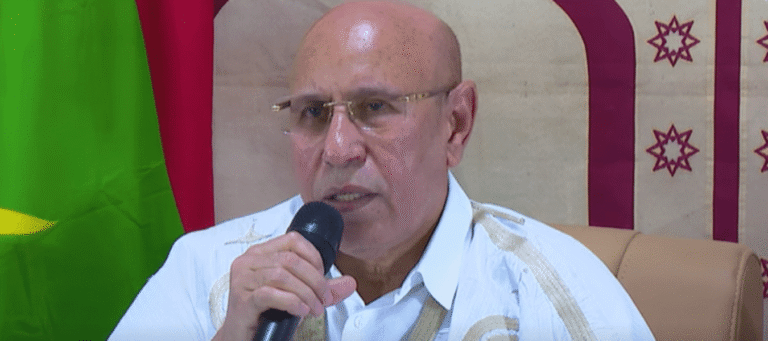
Mauritanian President Mohamed Ould Cheikh El Ghazouani issued a strong call on Tuesday for the nation’s youth to actively pursue employment in agriculture and livestock farming, asserting that the state stands ready to provide necessary support.
During a meeting with officials and local figures in the southeastern city of Amourj, President Ghazouani openly questioned the paradox of the country importing agricultural products from neighboring nations despite possessing fertile land and a large pool of unemployed youth.
“Why aren’t young people investing in agriculture and livestock farming?” the President asked, according to the Mauritanian Information Agency (AMI).
President Ghazouani was emphatic about the need to reject complacency, dependency, and a disregard for work. He stated it was unacceptable that foreigners benefit from the thousands of job opportunities available in sectors like construction, public works, fishing, and agriculture, while young Mauritanians complain of unemployment.
The case of the Néma Dairy plant
The Mauritanian leader used the example of the Néma dairy plant (in the southeast) to highlight the gap between potential and reality. He detailed the difficulties hindering its productivity and the state’s efforts to save the facility.
President Ghazouani expressed astonishment that the Néma plant, which has the capacity to process 30,000 liters of milk per day, consistently struggles with a milk supply shortfall. The highest figure ever recorded was a mere 5,200 liters.
“How can we continue to consume powdered milk when we have a large livestock population? And why haven’t the farmers taken advantage of the factory by supplying large quantities of milk?” he questioned.
He concluded that overcoming this shortfall requires building upon successful regional experiences, noting that the development of forage crops is crucial to facilitating the work of livestock farmers.
Creating the conditions for success
Mohamed Ould Cheikh El Ghazouani stressed that success is contingent on creating suitable conditions and an appropriate environment. This includes strategic investment in livestock health and breed improvement, establishing forage farms, drilling artesian wells, and developing the dairy industry.
The President urged young people to draw inspiration from successful local initiatives and, with private sector support, launch their own projects. He assured them that the market is available, the techniques exist, and the necessary inputs are readily accessible.
The meeting concluded after local officials and stakeholders voiced their challenges and problems within the Amourj district.
AC/Sf/fss/abj/APA