





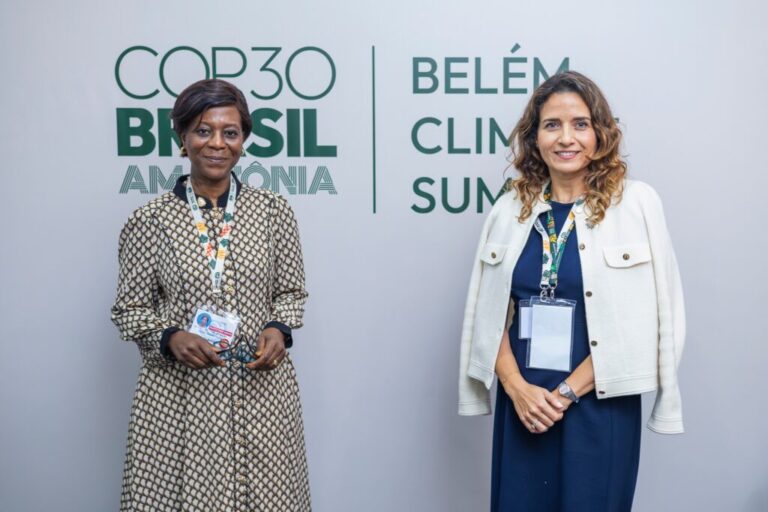
Morocco and the Republic of Congo have reaffirmed their strong commitment to boosting bilateral and regional cooperation focused on sustainable development and environmental transition.
This joint commitment was solidified during a meeting held on the sidelines of the 30th United Nations Climate Change Conference (COP30) in Belem, Brazil. The Moroccan side was represented by Leila Benali, Minister of Energy Transition and Sustainable Development, and the Congolese delegation by Arlette Soudan-Nonault, Minister of the Environment, Sustainable Development and the Congo Basin. Ms. Soudan-Nonault also serves as the Executive Secretary of both the Congo Basin Climate Commission (CCBC) and the Congo Basin Blue Fund.
The two officials welcomed the significant momentum generated by the Bilateral Cooperation Agreement on the Environment and Sustainable Development, which was signed in August 2024. According to a Moroccan source, this agreement provides a framework for sharing technical experiences in key areas such as environmental governance, the circular economy, and sustainable energy transition.
Discussions also focused on the progress of the CCBC’s vital work, including its Basin financing strategy and preparations for next year’s strategic donor roundtable. These events will lead up to the fourth CCBC Summit of Heads of State and Government, which will coincide with the Commission’s 10th anniversary.
In parallel, Minister Benali held a separate meeting with Abdullah Bin Ali Al-Amri, Chairman of the Environment Authority of the Sultanate of Oman and President of the seventh session of the United Nations Environment Assembly (UNEA-7).
This meeting fostered an in-depth exchange on global and regional climate priorities, particularly concerning climate change adaptation, climate finance, loss and damage, and technology transfer. Both ministers emphasized the necessity of intensified cooperation among partner countries to accelerate the implementation of climate commitments and build greater resilience to climate change impacts.
Minister Benali took the opportunity to present Morocco’s vision for implementing its national climate policies, specifically detailing the country’s NDC3.0 (Nationally Determined Contribution). This updated framework includes methodological innovations for the planning, transparency, and monitoring of climate commitments that Morocco believes could serve as inspiration for other developing nations. Discussions also highlighted the priorities of Oman’s UNAE-7 presidency, focusing on strengthening synergies between multilateral environmental agreements.
AK/ac/Sf/fss/abj/APA