





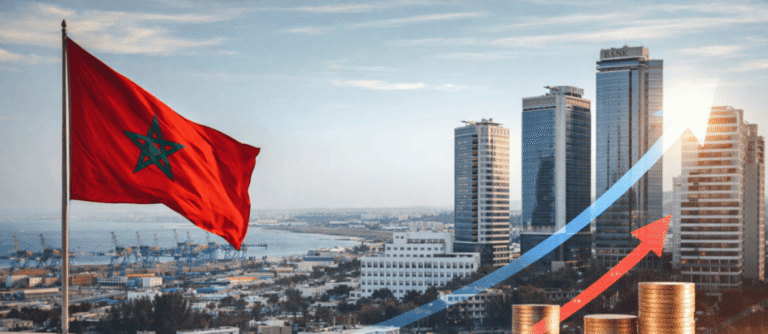
Morocco’s economy recorded a robust growth rate of 4.9% in 2025, primarily driven by a strong recovery in the agricultural sector and powerful investment momentum.
According to national accounts published by the High Commission for Planning (HCP), this overall expansion occurred despite a noticeable slowdown across non-agricultural activities. The country’s gross domestic product (GDP) rose by 4.9% in volume terms in 2025, marking an improvement compared to the 4.4% growth rate recorded in 2024. Over the same period, growth in non-agricultural activities slowed down to 3.9%, falling from the 5.1% achieved a year earlier.
The primary sector acted as the main catalyst for this economic acceleration, expanding by 7.1% after a sharp contraction of 5.1% in 2024. Agriculture itself rebounded strongly with an 8.2% increase that successfully offset the previous year’s decline, even though the fisheries sub-sector experienced a 13% drop. Meanwhile, the secondary sector posted a slight deceleration, growing by 3.3% compared to 3.8% in 2024. Within this sector, mining activities performed well with a 7.5% rise, while manufacturing eased to 1.9%. Construction and public works stood out positively with a 6.7% increase, improving on its 2024 performance, though utilities like electricity, gas, water, and sanitation activities slowed down sharply.
In the services sector, overall growth eased to 4.3% from 5.6% the previous year. Transport and storage increased by 4.2%, while accommodation and food services maintained steady expansion at 7%. On the downside, financial and insurance activities slowed, and information and communication services faced a decline. On the demand side, household consumption slowed down significantly to 1.2%, dropping from 2.9% in 2024, while public consumption grew more moderately at 5.1%.
Conversely, gross investment maintained strong upward momentum, rising by 16.3% following a 13.9% increase the year before, making a substantial contribution to the overall economic expansion. At current prices, the total GDP increased by 6.5%, reflecting a moderate and stable inflation rate estimated at 1.6%. Ultimately, the HCP concluded that domestic demand played a decisive role in fueling this progress, confirming the central importance of investment in shaping the country’s current economic dynamics.
MK/te/lb/abj/APA