



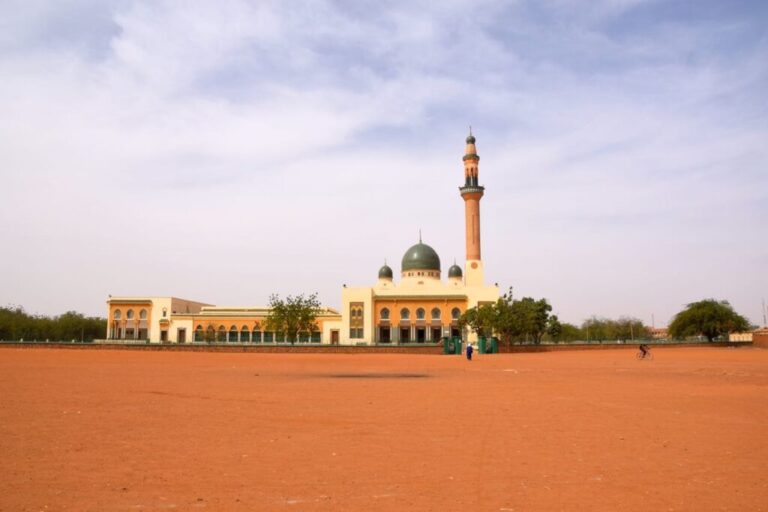
The municipal authorities of Niamey have adopted a decree regulating the establishment, construction, extension and occupation of the areas of mosques and other places of worship in the Nigerien capital, including a six-month period granted to existing establishments to have their administrative and land situation examined.
Signed on November 17, 2026 by the delegated administrator of the City of Niamey, Colonel Boubacar Soumana Garanke, the decree aims to regulate religious constructions in the five municipal districts, with regard to the rules of town planning, security, health and public tranquility.
The decree subjects any new establishment, construction or extension to prior administrative authorization. Promoters must in particular prove the legal availability of the land, its regular use, present a technical file, including the plans and obtain the required authorizations.
The decree also prohibits permanent extensions on sidewalks and roadways, the occupation of gutters as well as encroachment on land reserves and public roads.
Temporary installations may, however, be authorized, within a limit of two meters beyond the plot, subject to written authorization and the absence of disruption to traffic and networks.
Temporary exemptions are also provided for during religious gatherings, in particular Friday prayers, Ramadan, Tabaski and Mawlid.
The installations concerned must be dismantled, secure and limited in time and space.
The system also provides for requirements in terms of sanitation, waste management, fire safety and prevention of noise pollution linked in particular to the use of loudspeakers.
The parking of worshipers must not obstruct traffic or transform public roads into permanent parking spaces.
A general census of mosques in the five municipal districts has also been instituted. It must make it possible to document their location, their land situation, their surface area, their construction conditions, any encroachments as well as their sanitation and security systems.
The technical, town planning and hygiene services and the municipal police are responsible for monitoring the application of these provisions.
Breaches may result in suspension of work, removal of irregular installations, release of public rights-of-way, restoration of the premises or fines provided for by the texts in force.
The decree provides for a period of six months from its publication to allow existing mosques to have their situation examined.
However, this period does not prevent immediate interventions in the event of illegal occupation of public property or danger.
In its considerations, the municipal administration justifies this regulation by the urban and demographic expansion of Niamey, the multiplication of places of worship and the irregular occupations of roads, sidewalks and land reserves, while recalling that freedom of worship must be exercised with respect for public order and the laws.
AC/Sf/fss/gik/APA