





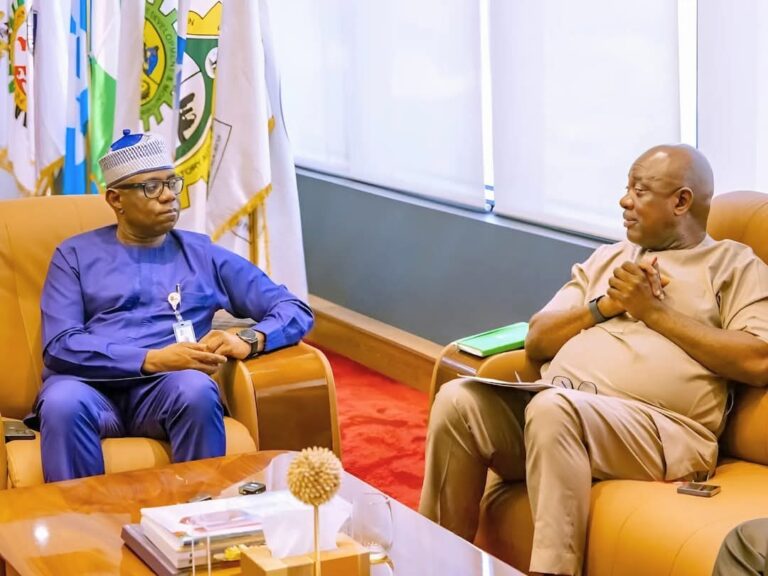
The Group Chief Executive Officer of Nigerian National Petroleum Company Limited (NNPCL), Mr Bayo Ojulari, says that Nigeria is targeting 60 billion dollars in new investments over the next five to seven years to expand gas infrastructure.
Addressing the global audience from 150 countries at the opening of the Gastech Exhibition and Conference in Milan, Italy, Mr. Ojulari said that the Nigerian Government was seeking the investment to boost industrialisation and reinforce the country’s position in the global energy market.
According to him, the planned investment is aimed at scaling up Nigeria’s natural gas production to 12 billion cubic feet per day and expanding the refinery capacity to meet growing global energy demand.
“We are seeking at least 60 billion dollars in investment over the next five to seven years, which for our oil and gas industry is just the tip of the iceberg.
“We are seeking investors to grow production,” he said.
Ojulari said that the Petroleum Industry Act (PIA), signed into law in 2021, transformed the NNPC into a limited liability company, enabling it to access direct funding and forge global partnerships.
He said that the company was currently producing about 1.6 million barrels of crude oil per day (bpd) with a mandate to grow output to 2 million bpd by 2027 and 3 million bpd by 2030.
He highlighted the ongoing projects that include the Ajaokuta–Kaduna–Kano (AKK) pipeline, the extension of the West African Gas Pipeline to Morocco and Europe, as well as the expansion of the Nigeria LNG project.
According to him, Nigeria already supplies 60 per cent of LNG to Portugal and Spain, and is currently on Train 6, constructing Train 7 to be completed in 2026, with plans for Trains 8 and 9.
“Nigeria has one of the best-run LNG businesses globally. We want to take advantage of the current high energy demand, which is also expected to go even higher,” he said.
Speaking on clean energy, Ojulari said that the government was driving LPG adoption and had launched a programme to deliver 2 million cylinders nationwide, while rolling out a Compressed Natural Gas (CNG) transition scheme for vehicles and machinery.
On Nigeria’s role in global energy security, he added that geopolitical shifts, such as the Russia-Ukraine-war, had accelerated regional pipeline projects to strengthen energy security.
The NNPCL boss explained that Nigeria has over 200 undeveloped oil and gas fields, describing them as Greenfield opportunities for international investors.
On how foreign policy shifts affect Nigeria’s energy sector, Ojulari said that the country had been hosting investments from diverse global players, including ExxonMobil, Chevron, Shell, Agip and Total.
“Nigeria is a global market. While foreign policies do impact us, our focus is on creating a stable market and building the right partnerships,” local media reports on Wednesday quoted Ojulari as saying.
GIK/APA