





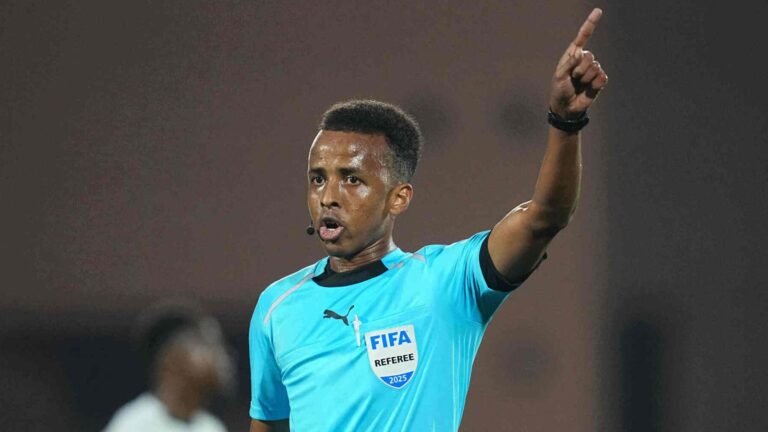
Somalia’s federal government on Saturday rejected allegations that its highly rated international football referee Omar Artan has ties to terrorist groups.
The United States last Tuesday denied Artan entry into the country to officiate the 2026 World Cup because of “his alleged links to suspected members of terror organisations”.
He returned to a hero’s welcome in Mogadishu where he was serenaded by government officials, football authroties and fans on Wednesday. He also met President Hassan Sheikh Mohamud.
Somali Defence Minister Ahmed Moallim Fiqi said the US claim linking Artan to al-shabaab was grossly untrue.
“The Somali government can confirm that Omar Artan has no connection whatsoever with terrorism,” Fiqi told reporters in Mogadishu.
“It is embarrassing enough for the United States that a person granted a visa by its own embassy is later accused of terrorism and sent back”.
Fiqi reiterated that the government had found no evidence linking Artan to extremist groups, describing the controversy surrounging him as an isolated case that would not affect relations between Mogadishu and Washington.
Somalia’s government has maintained that the accusations against the internationally recognised referee are unfounded and unsupported by evidence.
“The Federal Government of Somalia once again confirms that Omar Artan has no involvement in terrorist organisations,” he re-emphasised.
The minister also stressed Somalia’s appreciation for long-standing U.S. support, particularly in the areas of security assistance, military training, and institutional development.
Who is Omar Artan?
Omar Artan, a Somali football referee, was born on June 6, 1992. Artan began his refereeing career in local Somali leagues and became an official referee in the Somalia First Division. He has been a member of the FIFA–listed referees since 2018.
Artan was the first referee from Somalia to take charge of a continental final, overseeing Egyptian side Pyramids FC’ 2024-25 triumph over South Africa’s Mamelodi Sundown in Cairo.
In April 2026, Artan was appointed for the FIFA World Cup. He was a part of a nine-member contingent from Africa that included three referees and six assistant referees selected.
He was the first Somali referee selected for a FIFA World Cup tournament, among three central referees chosen from Africa.
However, Artan was not allowed to enter the United States and was removed from the tournament, generating controversy.
He was poised to be the first Somali referee to officiate at a World Cup, selected for the tournament which began last Thursday in the United States, Canada and Mexico.
But shortly after landing in Miami, where the referees’ training base is located, was detained and questioned for 11 hours, he says, before being sent back home.
Artan told The New York Times he was questioned repeatedly about Somalia’s al-Shabab, saying he did not know anything about the militant group.
He is not an isolated case in the buildup to the World Cup: 15 Iranian officials were denied entry to the US, according to Iranian state media, as has the official Iraqi team photographer.
An Iraqi player, Aymen Hussein, and other teams say they have been subjected to intensive and sometimes invasive searches at the border.
The U.S. government gave assurances to FIFA years ahead of the soccer tournament that “eligible athletes, officials and fans from all countries around the world” would be able to attend.
But preparations for the tournament faced uncertainty due to travel bans and restrictions imposed under President Donald Trump that prevent or severely limit entry to the U.S. for citizens of 39 countries including Somalia.
Other World Cup tournaments were far from flawless, from the authoritarianism of Russia in 2018 and the human rights concerns of Qatar in 2022, right back to the tournaments held under Mussolini’s Italy in 1934 and Argentina’s junta in 1978. But the spectacle of refusing entry to an accredited referee is unprecedented in the modern era, triggering widespread criticism domestically and internationally.
Former Secretary of State Hillary Clinton called it “terribly backward” for the U.S. to be “flippantly barring officials from entering the country to do their jobs.”
Retired Arsenal and England forward Ian Wright said in a video post that the event was becoming the “World Cup of chaos,” asking: “Is this how the hosts behave really for the greatest game, the greatest tournament in the world?”
MG/as/APA