





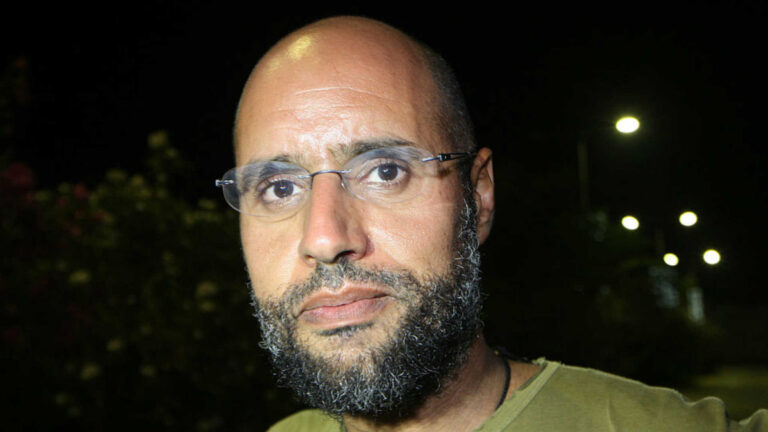
Pro-Gaddafi figures claim they can move beyond the elimination of Saif al-Islam Gaddafi and prepare a political alternative—statements that barely conceal persistent fractures and the absence of credible leadership.
Officials and supporters of Libya’s former regime have stepped up public statements in recent days to signal their intention to sustain political momentum following the killing of Saif al-Islam Gaddafi. This rhetoric of resilience seeks to project an image of continuity, even as the pro-Gaddafi camp remains deeply fragmented and deprived of a unifying figure.
Othman Baraka, presented as a leading figure of the “National Movement” backing Saif al-Islam, said supporters of the former regime, despite ongoing instability, possessed the organisational and political capacity to “move beyond” the loss of their leader. According to him, the movement would be able to ensure a transition toward an alternative leadership framework without calling its ideological orientation into question.
This optimistic reading contrasts with the caution expressed by other actors within the same camp. Sources close to Ahmed Gaddaf Al-Dam, a senior figure of the Libyan National Struggle Front, told the daily Asharq Al-Awsat that it was premature to speak of a successor or a new leader.
Mourning ceremonies still under way in Bani Walid, 172 kilometers south of Tripoli, also serve as a reminder of a harsher reality: the absence of a consensus and the difficulty of translating emotion into a structured political project.
A similar note of caution was struck by Nasser Saeed, spokesperson for the Libyan National Popular Movement. While he anticipates the eventual formation of a political leadership, he deferred the question of a leader or symbolic figure to a later stage.
The project, he insisted, would be “ideological and doctrinal, not tied to individuals.” The statement reads as much like a declaration of principle as an implicit admission: without a figure to embody that ideology, mobilisation remains fragile.
In practice, supporters of the former regime remain scattered among competing structures, political organisations and independent personalities. The Libyan National Popular Movement, founded in 2012, and the Libyan Popular Front for the Liberation of Libya, created in 2016 by political figures and tribal leaders in support of Saif al-Islam, illustrate this fragmentation. Each claims historical or ideological legitimacy, yet none has succeeded in asserting itself as a unifying pole.
Within Libya’s already fragmented political landscape, such statements amount as much to communication efforts as to a genuinely operational strategy. Invoking a project “beyond individuals” attempts to fill the vacuum left by Saif al-Islam’s demise, but it neither resolves internal rivalries nor addresses the lack of institutional grounding.
Rather than a controlled transition, the pro-regime post-Gaddafi phase appears set to unfold as an uncertain recomposition, torn between nostalgia, divisions and a search for legitimacy.
MK/ac/lb/as/APA