





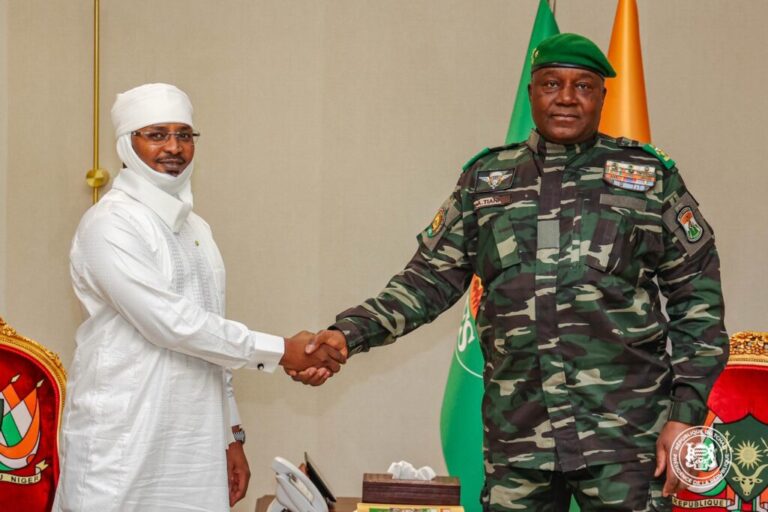
Chadian President Mahamat Idriss Déby Itno arrived in Niamey on Wednesday, August 6, for a two-day official visit, where he was welcomed by Niger’s transitional leader, General Abdourahamane Tiani.
The visit marks a new milestone in bilateral ties between N’Djamena and Niamey, set against the backdrop of a shifting geopolitical landscape in the Sahel.
The Chadian President was received at Diori Hamani International Airport by senior members of Niger’s transitional government in a display of pan-Sahelian solidarity and camaraderie.
The Chadian embassy in Niamey had mobilized members of the Chadian community for the occasion. Ambassador Abdoulaye Abdelkerim Abbo Grou convened Chadian nationals at 8:00 a.m. at the chancery in Koira-Kano before leading a formal convoy to the airport at 9:00 a.m.
This visit comes at a time when the original structure of the G5 Sahel, the regional counterterrorism alliance founded in 2014, has collapsed following the successive withdrawals of Mali, Burkina Faso, and Niger.
The evolving regional dynamics have prompted new forms of bilateral cooperation, as traditional alliances are increasingly being redefined.
The meeting between Déby Itno and General Tiani reflects shared security concerns, particularly regarding the fight against jihadist groups operating in the Lake Chad Basin.
It also signals a deepening of bilateral collaboration at a time when both nations are reassessing their strategic partnerships.
In November 2024, Chad announced it was ending its military agreements with France, prompting the withdrawal of French troops from its territory.
President Déby’s trip also builds on his earlier role in efforts to mediate Niger’s political crisis. On July 30, 2023, he traveled to Niamey via Abuja at the invitation of Bola Ahmed Tinubu, then chair of ECOWAS.
During that mission, he met with ousted President Mohamed Bazoum, General Tiani, and former President Mahamadou Issoufou, in a bid to defuse rising tensions.
More recently, on June 9, 2024, General Tiani received a high-level Chadian delegation led by State Minister Mahamat Ahmad Alhabo, who delivered a personal message from Déby.
The envoy emphasized the “deeply rooted geographical, historical and cultural ties” between the two countries and underscored the frequent exchanges between the two heads of state aimed at sharing views, experiences, and mutual solidarity.
Shortly thereafter, Nigerien Prime Minister Ali Mahamane Lamine Zeine paid a visit to N’Djamena, carrying a personal letter from General Tiani to his Chadian counterpart.
These regular exchanges underscore the resilience of a direct diplomatic channel between Niamey and N’Djamena, at a time when Niger, Mali, and Burkina Faso have withdrawn from ECOWAS to form a new political bloc under the Alliance of Sahel States (AES).
In this fragmented institutional landscape, President Déby Itno’s visit highlights the growing importance of reinforced bilateral dialogue. As traditional multilateral frameworks like the G5 Sahel give way to more flexible, pragmatic alliances, Chad and Niger appear committed to building partnerships rooted in shared realities and immediate regional priorities.
CA/ac/sf/lb/gik/APA