





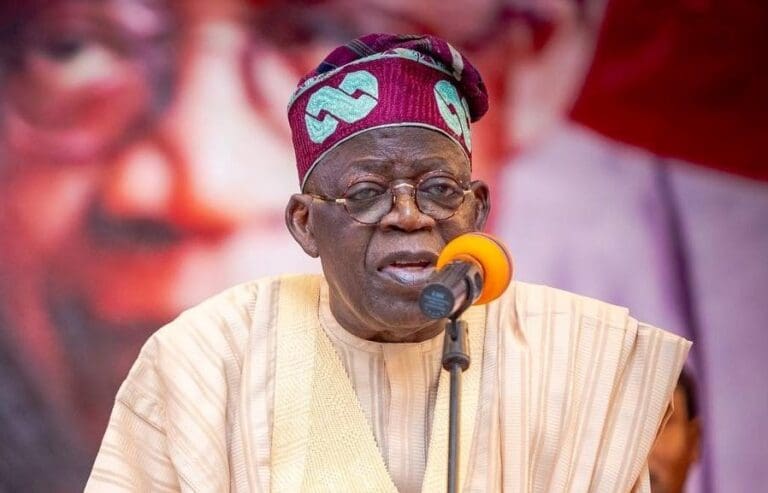
Nigeria’s President Bola Tinubu has appealed to Nigerian lawmakers to put forth innovative legislation that further encourages industrial development and job creation in our urban centres while also drafting laws that improve food security and production.
Addressing the joint session of the country’s National Assembly on Thursday in Abuja as part of the Democracy Day celebration, Tinubu said: “As we enter the second half of our term to put forth innovative legislation that further encourages industrial development and job creation in our urban centres while also drafting laws that improve food security and production.”
He disclosed that the government introduced a comprehensive Tax Reform Package, which is a vital component of the nation’s economic re- engineering and assured the lawmakers that he was looking forward to “signing them into law soon”.
“Again, your collaboration across party lines on these bills has been a model of democratic partnership. As elected leaders, we must continue to do more to make real the dream of Nigeria’s political and economic democracy.
“We must be vigilant in expanding the political space. We must always value dialogue over dictatorship, persuasion over suppression and rights over might. Be tolerant and broad-minded in your legislative action regarding speech and civil liberties,” he said.
Speaking on the claim that Nigeria was moving towards a one party state, President Tinubu said that “one-party state is not in the offing. Nor should it ever be.”
Recalling some of the achievements of his administration, Tinubu
said: ”Upon assuming office, my team and I moved to reform our ailing economy. We introduced fundamental reforms to correct structural imbalances that prevented maximum growth.
“We are already seeing results. GDP grew by 3.4 per cent in 2024, with Q4 hitting 4.6 per cent, the highest quarter of growth in over a decade,” he said.
According to him, inflation is easing gradually, steadying the price of food staples like rice and beans. Our net foreign reserves have increased fivefold, and the Naira exchange rate has stabilised.
“Our balance of payments position is positive; our sovereign credit rating is improving as we continue to promote oil and non-oil exports. States now do not need to go about borrowing to pay salaries.
“In less than one year, over one hundred thousand Nigerians, including thirty-five thousand civil servants, have benefited from affordable consumer credit through the Nigerian Consumer Credit Corporation (CREDICORP), enabling them to purchase vehicles, light up and improve their homes and purchase life essentials. This July, we will launch a bold new initiative to empower four hundred thousand young Nigerians, including youth corpers, with consumer credit.
“We are committed to giving more opportunities to young people through job creation and skills development. Through such programmes as NELFUND, we are investing in education, vocational training, apprenticeships, and internships to ensure our youth are job-ready and future-ready.
“In addition, we have embarked on an ambitious project to lay fibre optic cables across the nation, a transformative step toward bridging the digital divide and fostering greater connectivity. This initiative promises not only to enhance the speed and reliability of internet access but also to revolutionize how businesses operate, how students learn, and how communities stay connected. By extending this critical infrastructure, we are empowering entrepreneurs, enabling digital education, and providing the tools for our youth to compete in a globalized world,” he said.
He also said that “Nigeria First” policy would further enhance progress as the government consolidates market-driven growth, while the improved economic performance is encouraging and validates the soundness of the policy measures of the government.
“Our medium-term growth target remains an economy growing at a 7 per cent clip with a stronger manufacturing base. We must learn to produce and grow most of our food and we are on the path to achieving food sovereignty.
“These and other reforms have placed the economy on a more rational footing where critical decisions regarding large-scale investment can now be made.>
As part of his address, President Tinubu decorated the presiding officers of the National Assembly with their National Honours and announced the conferment of National Honours to more than 34 Nigerians, who he described as pillars and martyrs of democracy.
Some of the recipients of the National Honours included Prof Wole Soyinka, Kudirat Abiola, Ken Saro-Wiwa, Prof. Olatunji Dare, journalist and journalism teacher; Kunle Ajibade Nosa Igiebor, Dapo Olorunyomi Bayo Onanuga, Ayo Obe, Dare Babarinsa and Bishop Matthew Hassan Kukah.
It will be recalled that the Nigerian government changed its Democracy Day from May 29 to June 12 as a mark of recognition of the aborted election held on June 12, 1993, and won by Late Mohood Abiola, but annulled by the military government headed by General Ibrahim Babangida.
GIK/APA