





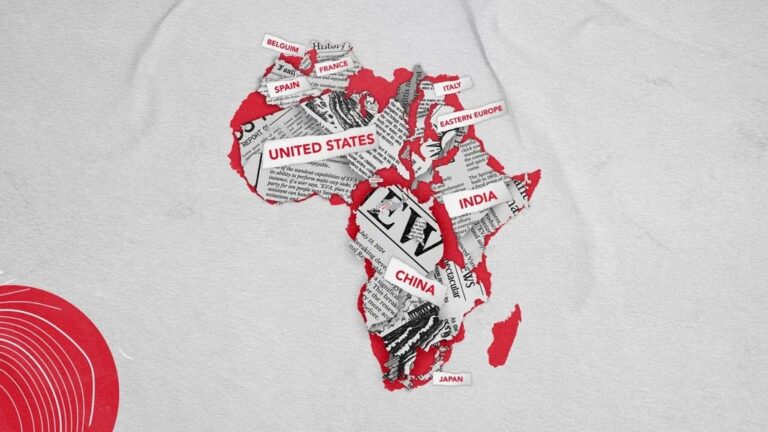
A quiet revolution is unfolding across Africa – not in parliaments or protest squares but on the walls of classrooms, in the pages of textbooks and on the screens of smartphones.
At the heart of it is a map. Not just any map, but the Mercator projection, a 16th-century cartographic tool that critics say has long distorted Africa’s true size and, with it, its global standing.
Now, a growing coalition of African voices is demanding change.
The African Union (AU) has formally endorsed the “Correct The Map” campaign, which calls for the replacement of the Mercator map with the Equal Earth projection – a modern alternative that accurately reflects the relative size of continents.
According to the AU, Africa’s true size is 30.37 million square kilometres (11.73 million square miles) and is big enough to fit Europe, China and the United States combined, with space left over.
The continent is also said to be more than three times the size of the US and stretches 8,000 kilometres (5,000 miles) from north to south.
The Mercator, designed by Flemish cartographer Gerardus Mercator in 1569 for maritime navigation, preserves shapes but grossly distorts scale, shrinking equatorial regions like Africa while inflating landmasses near the poles.
“It might seem to be just a map, but in reality, it is not,” said AU Commission Deputy Chairperson Selma Malika Haddadi.
She argued that when Africa is misrepresented in size, the world’s perception of the continent is also distorted – in media, education and policy.
Africa, the world’s second-largest continent by land area and home to over a billion people, often appears dwarfed on Mercator maps – smaller than Greenland despite being 14 times larger.
This visual misrepresentation, campaigners argue, reinforces colonial-era narratives that portray Africa as marginal, underdeveloped and peripheral to global affairs.
The implications go far beyond cartography.
“Maps shape how we see ourselves and how others see us,” said Carlos Lopes, professor at the University of Cape Town and one of the proponents of the “Correct the Map” campaign.
“If Africa appears smaller than it is, so does its weight in the imagination of citizens and decision-makers. Correcting the map is not vanity – it is reclaiming reality.”
The campaign, led by advocacy groups Africa No Filter and Speak Up Africa, has gained traction across the continent.
As of 22 August, their petition had surpassed its goal of 5,000 signatures. A total of 5,100 people had signed the petition.
Speak Up Africa co-founder Fara Ndiaye noted the psychological impact of distorted maps on African children.
“They grow up thinking Africa is modest in size when, in reality, it’s gigantic—larger than the US, China, India, Japan and much of Europe combined. Perception translates into confidence and confidence into action.”
The Equal Earth map, developed in 2017 by cartographer Tom Patterson and colleagues, offers a more accurate representation of landmass sizes although it distorts shapes.
It has already been adopted by institutions like the World Bank for static maps and campaigners are urging global bodies – including the United Nations – to follow suit.
“As Africa becomes increasingly central to solving global challenges, it is critical to represent its true scale. That’s why the Correct The Map campaign calls on the United Nations, as the global leader in international cooperation, and the BBC, as a global leading international media organisation, to adopt the Equal Earth projection in their data, reports, and materials that include world maps,” read the petition.
“With their influence, these institutions can set a new standard and encourage others to follow suit in ensuring Africa is represented accurately as a critical driver of global growth and development.”
The AU’s endorsement marks a turning point.
“It’s the first time a pan-African institution has taken a clear position on the visual representation of Africa,” Ndiaye said.
This transforms a cultural and civic demand into a continental policy aimed at the entire world, he argued.
The Mercator projection remains widely used, including by tech platforms like Google Maps, which still defaults to Mercator on mobile phones.
But the tide may be turning. The AU has pledged to advocate for wider adoption of Equal Earth and discuss collective action with its 55 member states.
According to political analyst Donald Porusingazi, the map debate is emblematic of a broader postcolonial reckoning – a push to rewrite Africa’s place in the world not just through policy but through perception.
“Maps are instruments of power and Africa is ready to redraw the lines.”
JN/APA