





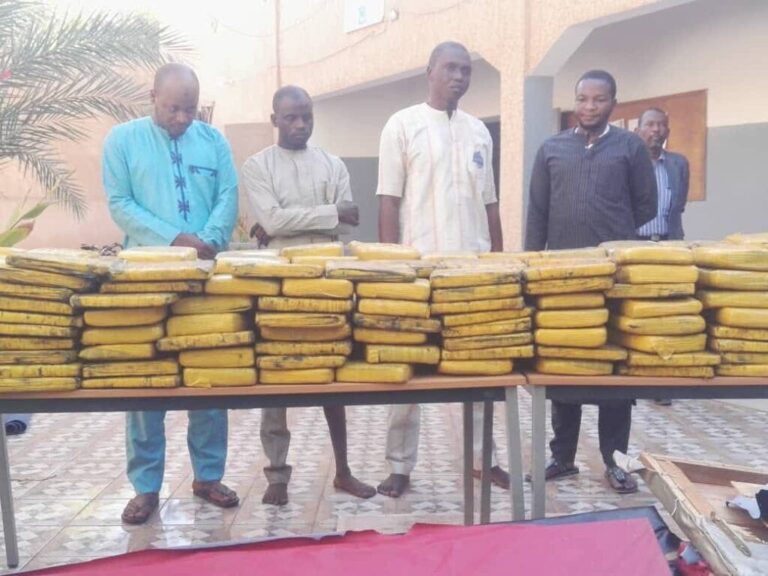
A study published by the Global Initiative Against Transnational Organized Crime (GI-TOC) reveals that land routes linking Mali, Niger, and Libya continue to fuel criminal networks, some state-linked actors, and several armed groups.
This is despite the conflicts, coups, and political upheavals in the region.
The land corridor linking Mali, Niger, and Libya remains one of the main transit routes for cocaine between West Africa and European markets, despite the armed conflicts, coups, and political upheavals in the region, according to a report published in August by the GI-TOC.
The document emphasises that, while the majority of cocaine destined for Europe transits by sea, the land routes crossing the Sahel play a crucial role in the war economies and protection systems that fuel regional conflicts.
According to the authors, cocaine trafficking in West Africa has increased sharply since 2019, driven by rising
production in Latin America, European demand, and tighter controls on direct maritime routes to Europe.
The report indicates that state-linked actors dominate the most lucrative segments of the trade in Mali, Niger, and Libya.
Armed groups primarily intervene by escorting convoys, securing routes, and maintaining territorial control, while jihadist organisations, notably the Islamic State in the Sahel (IS Sahel), derive indirect revenue from taxing shipments passing through their areas of influence.
In Mali, the offensive launched by the Malian Armed Forces (FAMa) in 2023 led to a reconfiguration of routes.
Convoys abandoned several traditional routes around Kidal in favour of longer routes passing through the Menaka region before reaching Niger.
In Niger, the July 2023 coup d’état caused a breakdown of the existing political protection systems, leading to significant disruption of cocaine and cannabis networks until the end of 2024.
The report estimates, however, that these networks gradually re-established themselves from mid-2025 onward, with increasing involvement from elements close to the Union of Nigeriens for Vigilance and Patriotism (UNVP), presented as a new actor providing protection for convoys.
In Libya, the routes crossing the Fezzan region remain crucial for cocaine transit to the Mediterranean. Despite clashes in 2025 and early 2026, several networks reportedly relocated their logistical bases to less heavily guarded areas, particularly around the Salvador crossing, through which, according to sources cited in the report, between 60 and 70 kilograms of cocaine per month are transported.
The document also highlights the continued use of light aircraft in regional trafficking. It notably recalls the so-called “Air Cocaine” affair of 2009, when a Boeing 727 from Latin America landed in northern Mali with several tons of cocaine, as well as the seizure of 2.6 tons of cocaine in Bissau in September 2024 aboard a private plane
that, according to investigators, was headed to Bamako.
Based on more than 150 interviews conducted between September 2025 and January 2026 in Mali, Niger, and Libya, the report concludes that the trans-Sahelian routes remain resilient and that cocaine trafficking continues to finance criminal networks, state-linked actors, and armed groups, making the Mali-Niger-Libya corridor a key factor in the instability plaguing the Sahel.
AC/Sf/fss/as/APA