



Nearly 2.9 million head of livestock and 40,000 herders and their accompanying staff are reportedly affected by restrictions on pastoral mobility within the basin encompassing Mali,
Mauritania, and Senegal.
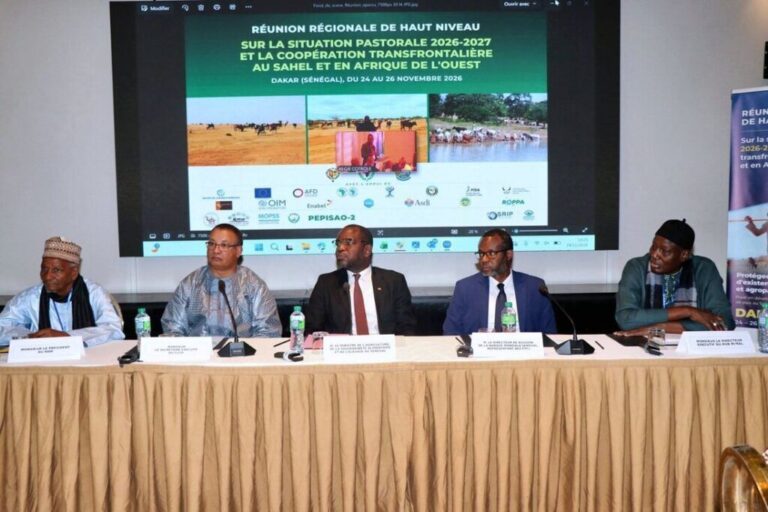
This is according to a regional study presented during a high-level meeting held in Dakar from November 24 to 26, 2026.
These estimates come from a study conducted by the Billital Maroobe Network (RBM), coordinated by the Permanent Interstate Committee for Drought Control in the Sahel (CILSS), with support from several international partners.
The Dakar meeting is examining the challenges of the 2026-2027 pastoral season, which has been marked by uneven rainfall distribution, fodder shortages, and persistent insecurity in several
Sahelian areas.
According to the CILSS, pasture deficits in some zones range from 25% to 90%. The premature drying up of water sources and restrictions on the movement of herds are intensifying pressure on available resources.
In the western basin – which includes Mali, Mauritania, and Senegal – the concentration of livestock in certain host areas increases the risk of conflict between mobile herders and resident communities.
The situation also impacts commercial activities linked to livestock farming, particularly livestock markets and supply chains for animal products.
Bringing together government representatives, regional institutions, and pastoral organisations, the discussions in Dakar aim to develop a coordinated response to mobility challenges and the risks threatening the livelihoods of herders.
The organisers hope to secure political and financial commitments, supported by a regional roadmap and a monitoring mechanism.
The meeting is set to conclude on Thursday, November 26, with proposals aimed at improving cross-border cooperation and preserving pastoral activities in the region.
MD/te/Sf/fss/as/APA